How to Read Prediction Markets: Price, Spread, Depth
A $0.65 YES share is not a 65% forecast. Learn how bid, ask, fees and order book depth set your break-even on prediction markets. A bet can lose its stake.
Published 10 min read
On this page
- Key takeaways
- How do prediction markets work: contracts that pay $1 or $0
- Reading a price as a probability
- What fees and the spread do to your break-even
- Order book depth: how much a price can carry
- Where prediction markets do well, and where they get it wrong
- Prediction markets vs polls and bookmakers
- Kalshi, decentralized markets and prediction market apps
- Checklist before you trust a price or place a bet
- Sources
- Frequently asked questions
- How do prediction markets work?
- Is there a prediction markets app that shows several venues at once?
- Why can't I buy a prediction market share at the price shown on screen?
- How do I calculate my break-even probability on a YES share?
- Does a sudden jump in a prediction market price always mean new information?
A prediction market price is not a forecast by itself. A YES share that last showed $0.65 becomes a usable probability only after you check the bid, the ask, the fees and how much money sits in the order book behind that price. On Polymarket's documentation, "Every share on Polymarket is priced between $0.00 and $1.00." This guide shows how perp traders can read prediction markets with the same tools they already use for perps: spread, depth, round-trip cost and the exact rules of the contract. It gives no trading signals and makes no promise of profit. A bet can lose its full stake.
Key takeaways
- A YES share pays $1 if the event happens and $0 if it does not, so the price works like an implied probability only within the bid-ask spread.
- On Polymarket, the displayed price is the midpoint of the spread, and if the spread is wider than $0.10, the last traded price is shown instead (Polymarket documentation).
- Your break-even probability is the price you actually pay plus fees per share, divided by the $1 payout, not the mid price on the screen.
- A thin order book can move the price on one order, and that move says nothing new about the event.
- Resolution rules decide the payout: a correct read of the event can still lose if the wording or data source works differently than you assumed.
How do prediction markets work: contracts that pay $1 or $0
A prediction market lists contracts on a yes-or-no question. A YES share pays $1 if the event happens and $0 if it does not. NO is the mirror. The price sits between $0 and $1 and moves with buying and selling on an order book.
Polymarket's help center (March 13, 2026) states that "When a market is created, there are initially zero shares and no pre-defined prices or odds" and that "Like the stock market, prices on Polymarket are a function of realtime supply & demand." Nobody sets the odds. Traders do.
Key differences from perps:
- No leverage and no funding payments.
- No liquidation price, but the position resolves to $0 or $1 on a fixed date.
- At resolution, a losing share is worth nothing. The whole stake goes.
Perp traders meet these markets on Hyperliquid (HIP-4), Polymarket and predict.fun. Prow shows bets on Hyperliquid, Polymarket and predict.fun in one feed. Check each venue's terms and whether it is available in your region. 18+ only.
Reading a price as a probability
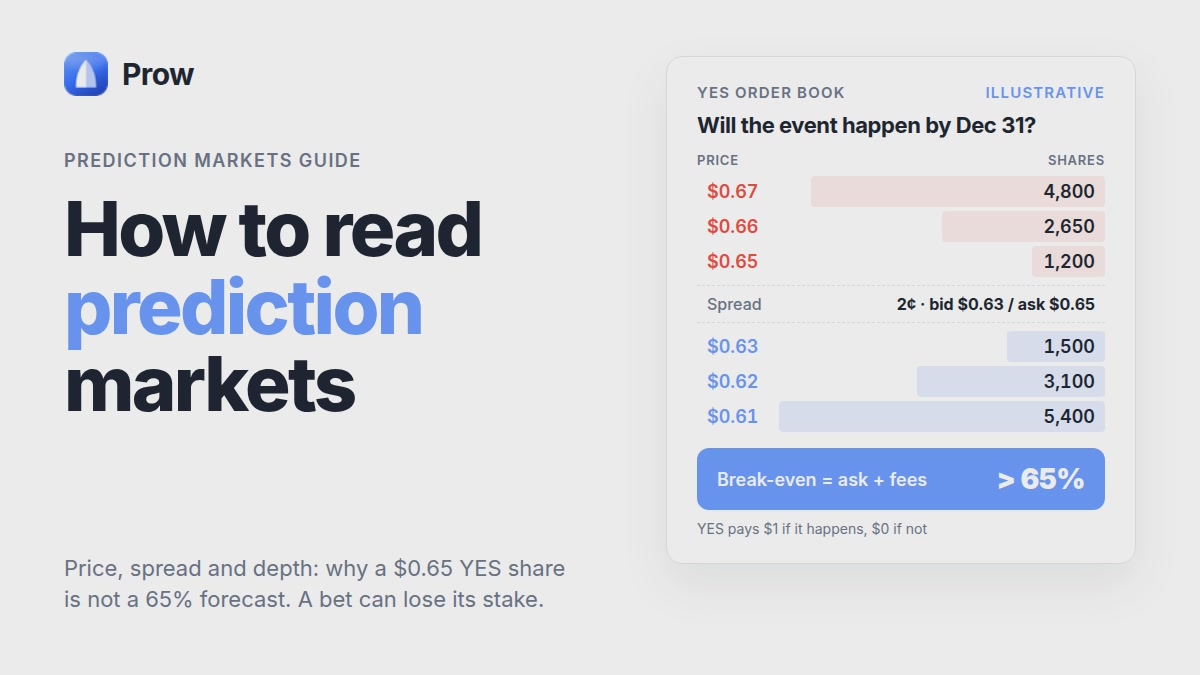
The mid price is the closest thing to the market's implied probability, but you cannot trade at it. You buy at the ask and sell at the bid.
An illustration (not live data):
- YES bid: $0.62
- YES ask: $0.65
- Mid: ($0.62 + $0.65) / 2 = $0.635, about 63.5%
Polymarket's own example says the same: "You won’t necessarily trade at $0.37—you’ll pay the ask ($0.40) when buying or receive the bid ($0.34) when selling" (Polymarket documentation).
If you buy YES at $0.65, the event has to be more likely than 65% for the bet to have a positive expected value, before fees. Not 63.5%.
Now check the other side. If the NO ask in this illustration is $0.38, then YES ask plus NO ask is $1.03. Those extra 3 cents are the spread cost of taking liquidity on both sides. They are not information about the event. As Wikipedia's entry on the bid-ask spread puts it, the spread is "one measure of the liquidity of the market and of the size of the transaction cost."
What fees and the spread do to your break-even
Fees and the spread push your break-even probability above the price on the screen. The formula is short:
Break-even probability = (entry price + fees per share) / $1 payout
Illustration: you buy YES at the $0.65 ask, and assume a fee of $0.01 per share (an assumed number for the math, not a venue figure). Break-even is $0.66 / $1 = 66%. The screen showed 63.5%. Your bet needs 66%.
Take actual trading and settlement fees from each venue's documentation and note the date you read them. Fee schedules change.
Exiting before resolution adds a second cost:
- You bought at the ask.
- You sell at the bid.
- You pay the spread again, plus any exit fee.
This is the same round-trip logic as an entry fee and exit fee on a perp. "For a round trip (a purchase and sale together) the liquidity demander pays the spread" (Wikipedia).
In Prow, venue fees apply. The Prow fee is 0% until Dec 31, 2026. Details on placing, selling and claiming bets are in the Prow Docs on prediction markets.
Order book depth: how much a price can carry
A price backed by a few hundred dollars says less than one backed by a deep, two-sided book. Polymarket notes that "large orders may move the price significantly" (Polymarket documentation).
Illustration of slippage, the same math as on a perp book:
- $300 of YES offered at $0.65
- The next offer is at $0.70
- You buy $1,000 of YES
- You get about 461.5 shares at $0.65 and 1,000 shares at $0.70
- Average price: about $0.684, and your break-even rises to about 68.4% before fees
The market still shows $0.65 until your order fills. Afterwards it may show $0.70. That jump came from your order, not from news.
Polymarket also switches the displayed number when books are thin: "If the bid-ask spread is wider than 10¢, the probability is shown as the last traded price" (Polymarket help center, March 13, 2026). A last trade can be old. Check when it happened.
Where prediction markets do well, and where they get it wrong
Prices tend to carry more information when the question is clear, the book is deep and many traders take part. They carry less when any of those conditions fail.
Conditions that help:
- A clear, verifiable outcome and a known resolution date.
- Many independent traders and two-sided depth.
- Inputs that update in public data, such as economic releases. A February 2026 Federal Reserve study, as summarized by Wikipedia on Kalshi, found that the "prediction market platform is a useful method for measuring macroeconomic expectations."
Ways it goes wrong:
- Thin books. One order moves the price several cents, as in the depth example above.
- Large traders. A single account with size can push the price on its own.
- Low-priced outcomes. A $0.03 share looks cheap, but the spread can be a large share of that price. Check what you actually pay.
- Ambiguous rules. A guide by Global Trading Outlook (October 29, 2026) points to terms such as "A reading exactly equal to the strike resolves No" and "revisions to the Underlying made after expiration will not be taken into account." Small wording like this decides payouts.
Accuracy is also debated. Political scientist John M. Sides is among those who "have challenged whether Kalshi efficiently and accurately aggregates information about outcomes" (Wikipedia).
Prediction markets vs polls and bookmakers
The three answer different questions. A poll measures stated opinion at one moment. A prediction market prices an expected outcome with money at stake. A bookmaker quotes odds that include its own margin.
To compare a bookmaker with a market, convert decimal odds to implied probability:
Implied probability = 1 / decimal odds
Illustration: odds of 1.80 and 2.00 on a two-way event give 55.6% and 50%. Together that is 105.6%. The 5.6 points above 100% are the bookmaker's margin. It plays the same role as YES ask plus NO ask above $1 on an exchange.
None of the three is a guarantee. Each has its own biases: polls in who answers, markets in who trades and how deep the book is, bookmakers in how they set the margin.
Kalshi, decentralized markets and prediction market apps
Kalshi is one widely discussed venue, and the public figures show how a platform's mix of users shapes its prices. Prow does not connect to Kalshi.
According to Wikipedia, sports betting "constitutes more than 90% of site activity," and "according to the site, there are 2.9 unprofitable users for each profitable one." Read that as a risk figure, not a forecast for any single bet.
Decentralized venues such as Polymarket, predict.fun and Hyperliquid's HIP-4 run on-chain order books. A prediction markets app that aggregates them lets you compare the same event across venues. In Prow Predictions you bet from your own venue accounts, and Prow does not hold the funds. See the Polymarket, predict.fun and Hyperliquid guide for how the feed works.
Checklist before you trust a price or place a bet
Run these checks before you read a price as a forecast or put money on it:
- Read the resolution rules. The exact question, the data source, the date and time, edge cases like a value equal to the strike, and the dispute process.
- Check the spread. Compare the mid with the ask you would actually pay. On Polymarket, a spread wider than $0.10 means the displayed number is the last trade.
- Check depth and recent volume. Estimate your average fill price for your size.
- Work out break-even after fees. Use fee figures from the venue's documentation, dated.
- Compare venues. If the same event is listed on several venues, compare the asks, not the mids.
- Size for a total loss. At resolution a share is worth $0 or $1, with nothing in between. Stake only what you can lose in full.
More on fees, round-trip costs and order books is in the Prow guides on outcome markets and perps.
Sources
- Prices & Orderbook - Polymarket Documentation, Polymarket
- How Are Prices Calculated? | Polymarket Help Center, Polymarket, March 13, 2026
- Bid–ask spread - Wikipedia, Wikipedia
- Kalshi - Wikipedia, Wikipedia
- How to read an event contract before you trade it: the terms, the fees and the CFTC filing | Global Trading Outlook, Global Trading Outlook, 29 October 2026
Frequently asked questions
How do prediction markets work?
A prediction market lists contracts on a yes-or-no question. A YES share pays $1 if the event happens and $0 if it does not, and NO is the mirror. Prices between $0 and $1 come from buying and selling on an order book, with no preset odds. Unlike perps, there is no leverage, funding or liquidation price, but a losing share is worth nothing at resolution.
Is there a prediction markets app that shows several venues at once?
Prow shows bets on Hyperliquid (HIP-4), Polymarket and predict.fun in one feed. Venue fees apply, and the Prow fee is 0% until Dec 31, 2026. Check each venue's terms and whether it is available in your region. Use is limited to adults 18 and over.
Why can't I buy a prediction market share at the price shown on screen?
On Polymarket the displayed price is usually the midpoint between the bid and the ask, and you cannot trade at the midpoint. You pay the ask when buying and receive the bid when selling. If the spread is wider than $0.10, Polymarket shows the last traded price instead, and that trade may be old.
How do I calculate my break-even probability on a YES share?
Add the price you actually pay and any fees per share, then divide by the $1 payout. For example, buying at a $0.65 ask with an assumed $0.01 fee gives a 66% break-even, even if the mid price suggests 63.5%. Take real fee figures from each venue's documentation and note the date you read them.
Does a sudden jump in a prediction market price always mean new information?
No. In a thin order book, one large order can use up the offers at one price and fill at higher levels. The displayed price then moves because of that order, not because of news about the event. Check how much money sits behind a price before you treat it as a probability.