Perpetual Futures: How Perps Work, Funding and Mark Price
Perpetual futures never expire. How index, mark and last price work, how hourly funding ties perps to spot, and why leverage can cost your whole margin.
Published 10 min read
On this page
- Key takeaways
- What perpetual futures are, and how they differ from dated futures
- Index, mark and last price: three prices on one contract
- Funding: what pulls the perp price toward spot
- One position from open to liquidation
- Where crypto perps trade: centralized exchanges vs on-chain order books
- Trading a perp through an app: keys and custody
- What a perp can cost you: fees, funding and the whole deposit
- Perpetual futures FAQ
- Do perps ever expire or settle?
- Which price triggers liquidation: mark or last?
- How often is funding paid?
- Sources
- Frequently asked questions
- Perpetual vs futures: what is the difference?
- How do perpetual futures work in crypto?
- Why does the same funding rate cost more at higher leverage?
- Why is liquidation based on the mark price and not the last trade?
- Does a non-custodial perp app protect my margin from liquidation?
Perpetual futures are contracts that track the price of an asset such as BTC but never expire. A dated future is pulled to spot by its settlement date. A perp has no such date, so venues use funding instead: a recurring payment between longs and shorts that rewards the side that moves the perp price back toward the index. You trade price exposure with margin, never the coin itself, and with leverage you can lose your whole margin.
Key takeaways
- A perpetual futures contract has no expiry date. It stays open until you close it or it is liquidated.
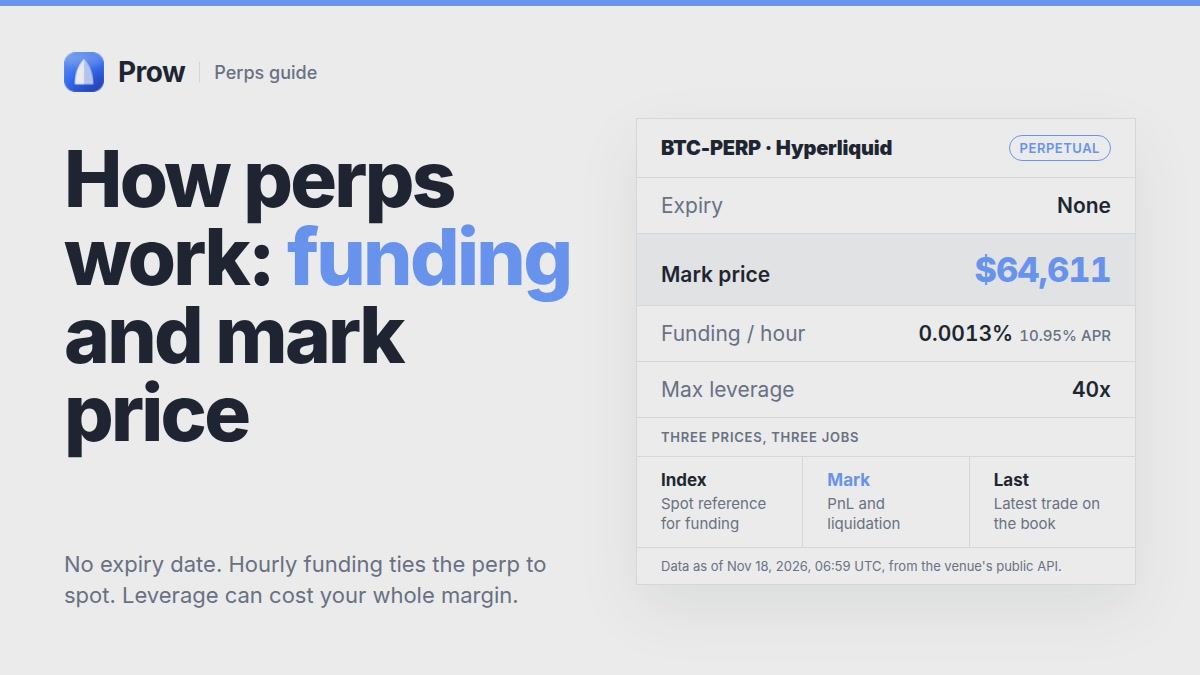
- Each perp has three prices: the index (spot from oracles), the mark (used for unrealized PnL and liquidation) and the last price (where orders fill).
- On Hyperliquid and Lighter, funding is paid every hour between traders, per each venue's documentation.
- On a 40x Hyperliquid market, an isolated long at 10x has about 8.9% of room before liquidation. At 40x it has about 1.3%.
- On a non-custodial setup, collateral stays in your own account on the venue, and leverage can still cost the entire margin.
What perpetual futures are, and how they differ from dated futures
A perpetual future is a futures contract without a settlement date. As Lighter's funding documentation puts it: "Unlike traditional futures contracts, perpetual futures do not have an expiration date."
This changes how the contract stays tied to spot:
- Dated future: the price converges to spot at expiry because the contract settles against it.
- Perp: there is no settlement, so a funding payment does the anchoring.
You never own or deliver the underlying asset. You post margin, usually USDC or a similar collateral, and gain exposure to the price move. The position stays open until you close it or the venue liquidates it. As long as it is open, it pays or receives funding.
The Perpetuals basics page in Prow Docs covers long, short, PnL and ROE. This article looks at the contract itself.
Index, mark and last price: three prices on one contract
One perp has three prices, and each has its own job. The index tracks spot, the mark decides PnL and liquidation, and the last price is where you actually fill.
- Index price. This is spot built from external data. Lighter's docs say it "uses a combination of oracles (Chainlink, Stork, Pyth) to determine the index price." Aster's documentation says index prices "are sourced from multiple providers including the Pyth Oracle."
- Mark price. On Aster, "the Mark Price serves as the reference for calculating unrealized PnL and triggering liquidations." Lighter states that "the mark price is used when deciding if liquidations should be happening." One stray trade on the order book should not liquidate you.
- Last price. This is where your order fills. Size, slippage and whether you are maker or taker all apply here.
The gap between the perp's price and the index is the premium, and funding responds to it. Lighter caps the premium in its mark calculation at 0.5% of the index price.
Funding: what pulls the perp price toward spot
A dated future converges with spot because settlement fixes its final price. A perp has no settlement date, so the venue charges for the gap every hour instead. Funding is that charge. It is a cash transfer between the two sides of the market, and its direction follows the premium. Aster's funding page puts it this way: "Positive funding rate: The contract price is above the Mark Price — long traders pay short traders." A negative rate reverses the flow, and shorts pay longs.
The pull comes from incentives. When the perp trades above spot, every hour in a long costs money and every hour in a short earns it. Some traders respond by shorting the perp and holding the coin, which adds selling pressure on the perp. When the perp trades below spot, the flow and the trade reverse.
The rules differ by venue:
- Hyperliquid: "Funding is accrued and paid every hour" and is "capped at 4% per hour" (Hyperliquid Wiki).
- Lighter: "Funding payments occur at each hour mark" and "are fully peer-to-peer with no fees taken by the exchange."
- Aster: the interest component of the rate is 0.01%, except BNBUSDT, where it is 0%.
On Oct 31, 2026, 06:00 UTC, Prow's live perp funding rates page showed these hourly BTC rates:
- Hyperliquid: 0.0013%/h
- Aster: 0.0013%/h
- Lighter: 0.0012%/h
These are a snapshot from one hour, not current values. To convert hourly to APR, multiply by 8,760. 0.0010%/h equals 8.76% APR.
Funding is charged on the position's notional value, not on the margin behind it. That makes leverage matter. Cost in dollars = notional × rate × hours. At 0.0010%/h, a $10,000 position pays $0.10 an hour, or $2.40 a day. Opened at 10x with $1,000 of margin, that $2.40 is 0.24% of the margin each day. Opened at 2x with $5,000, it is 0.048%. The rate is the same, but the share of your margin it takes is five times larger at 10x.
Rates change every hour and can flip sign. Funding gives traders a reason to close the premium. It does not guarantee that the perp price converges with spot, and on volatile days the gap can widen while funding is running.
One position from open to liquidation
An isolated 10x long on a 40x Hyperliquid market has about 8.9% of room before liquidation. At 40x that room drops to about 1.3%. Here is the arithmetic, with an illustrative entry price.
Setup:
- BTC long, isolated margin
- $10,000 notional, entry at $100,000
- 10x leverage, so $1,000 of margin
- Maintenance margin is half the initial margin at max leverage: 1.25% on a 40x market
Liquidation:
- Margin above maintenance: 10% − 1.25% = 8.75% of notional.
- Divide by (1 − 0.0125): about 8.86%.
- Liquidation price: about $91,140.
- At 40x, margin is $250. The room is (2.5% − 1.25%) / 0.9875, about 1.27%, so liquidation sits near $98,730.
The full formula is in the guide to liquidation price on Hyperliquid and Aster.
Holding for 7 days: at a flat 0.0013%/h, funding costs $10,000 × 0.0013% × 168 = $21.84. That is about 2.2% of the $1,000 margin at 10x, but about 8.7% of the $250 margin at 40x. Add the entry and exit fees, and break-even moves further from entry.
Cross margin pools margin across positions. In cross mode, the leverage you set on one trade does not limit how much of the account that trade can draw on.
Where crypto perps trade: centralized exchanges vs on-chain order books
On a centralized exchange, the exchange holds your collateral. On Hyperliquid, Aster and Lighter, collateral sits in your own account on the venue. The venues also differ in leverage caps, funding intervals and fees, and these numbers change.
Max leverage on BTC, Nov 18, 2026, 06:00 UTC (from Prow's perp markets on Hyperliquid, Aster and Lighter):
| Venue | BTC max leverage |
|---|---|
| Hyperliquid | 40x |
| Aster | 20x |
| Lighter | 50x |
Funding interval: Hyperliquid and Lighter document hourly payments. Pendle's documentation notes "8h intervals for Binance, 1h interval for Hyperliquid". For Aster, check its docs for the interval of each market.
A higher cap is a ceiling, not a better venue. Fees, liquidity and open interest vary by market and by hour. Compare them on the date you trade. The guide to max leverage on a perp DEX explains how leverage tiers work.
Trading a perp through an app: keys and custody
In Prow, your funds stay in your account on Hyperliquid, Aster or Lighter. Prow does not hold them. Orders are signed with a trading key that lives on your device.
How the key works:
- It is created in your browser when you connect a venue.
- You approve it once with a wallet signature.
- It is stored encrypted on your device and is never sent to Prow's servers.
- It can place trades but cannot withdraw funds.
- It expires after 180 days, and you can revoke it at any time.
Each order goes either to the venue with the best price for its size or to the venue you choose. Positions from all venues appear in one list, with liquidation and price alerts.
Non-custodial does not protect you from everything:
- A position can still be liquidated.
- The venue itself carries its own risks.
- A compromised device can expose the trading key.
The Hyperliquid first-trade guide walks through connecting a key step by step.
What a perp can cost you: fees, funding and the whole deposit
A perp trade costs an entry fee, an exit fee, any builder fee and funding for as long as you hold it. With leverage, it can also cost the whole margin.
The cost stack:
- Maker/taker fees: charged on entry and again on exit, at the venue's tier rates. Compare current tiers, with their date, on the perp DEX fees page.
- Builder fee: an extra fee an app can add on top of venue fees, which you approve with your wallet. Hyperliquid caps it at 0.1% on perps.
- Prow fee: 0% until Dec 31, 2026, then 0.025% per order on top of venue fees. There is no subscription, deposit fee or spread markup.
- Funding: it can run against a held position for weeks. On Aster, "if your balance is insufficient, fees may be taken from your position margin, potentially impacting your liquidation price."
Perpetual futures FAQ
Do perps ever expire or settle?
No. A perp has no expiration date and stays open until you close it or it is liquidated. The perp price can stay away from spot for some time. Funding pushes it back but does not force it to converge.
Which price triggers liquidation: mark or last?
The mark price. Aster and Lighter both document the mark price as the basis for liquidation. The last price is where your orders fill.
How often is funding paid?
On Hyperliquid and Lighter, every hour, per their documentation (checked November 2026). Hyperliquid uses the oracle price, not the mark price, to calculate the notional for funding. For Aster, check its docs for each market's interval. Prow's funding page shows all three as per-hour rates and APR, updated about every minute.
Sources
- Funding | Lighter Docs, Lighter
- Fair Price Marking | Lighter Docs, Lighter
- Stock Perpetuals | Aster, Aster
- Funding Rate | Aster, Aster
- Funding | Hyperliquid Wiki, Hyperliquid Wiki (community documentation)
- Chapter 0 - Understanding Funding Rates | Pendle Documentation, Pendle
Frequently asked questions
Perpetual vs futures: what is the difference?
A dated future settles against spot at its expiry date, which pulls its price to spot. A perpetual future has no settlement date and stays open until you close it or it is liquidated. Funding payments between longs and shorts keep it anchored to the index instead.
How do perpetual futures work in crypto?
You post margin, usually USDC or similar collateral, and get exposure to the price of an asset such as BTC without owning or delivering the coin. Unrealized PnL and liquidation are based on the mark price, and an open position pays or receives funding, every hour on Hyperliquid and Lighter. With leverage, you can lose your whole margin.
Why does the same funding rate cost more at higher leverage?
Funding is charged on the position's notional value, not on the margin behind it. At 0.0010% an hour, a $10,000 position pays $2.40 a day. That is 0.24% of the margin each day at 10x with $1,000 of margin, and 0.048% at 2x with $5,000.
Why is liquidation based on the mark price and not the last trade?
The last price is simply where orders fill, and one stray trade on the order book can move it. Venues such as Aster and Lighter use the mark price, which is built with reference to oracle-based index prices, to decide when liquidations happen. This keeps a single outlier fill from triggering a liquidation.
Does a non-custodial perp app protect my margin from liquidation?
No. On a non-custodial setup, your collateral stays in your own account on the venue, not with the app. Each position can still be liquidated, and leverage can still cost the entire margin.