Max Leverage on a Perp DEX: Tiers and Liquidation Risk
How max leverage works on Hyperliquid, Aster and Lighter: margin tiers, maintenance margin and how to turn leverage into liquidation distance.
Published 9 min read
On this page
- What max leverage on a perp DEX actually caps
- Why the limit drops as position size grows
- Hyperliquid: margin tiers
- Aster: leverage and notional brackets
- Lighter: margin fractions
- Worked example: same market, two sizes
- Max leverage on Hyperliquid, Aster and Lighter: where to read it
- Maintenance margin: where liquidation begins
- Leverage vs liquidation distance, in numbers
- The leverage you choose matters more than the cap
- A pre-trade leverage checklist (no signals)
- Setting and watching leverage in Prow
- Frequently asked questions
- How do I convert a margin fraction into a leverage number?
- Does cross margin let me go above a market's max leverage?
- Why does the same coin have a different max leverage on Hyperliquid, Aster and Lighter?
- Can fees and funding move my liquidation price?
- If I pick a lower leverage, can I still lose my whole margin?
The max leverage on a perp DEX is a ceiling the venue sets for each market, not for the whole exchange. It is the smallest initial margin the venue will accept. On Hyperliquid, Aster and Lighter it can also drop as your position grows. The number that decides your liquidation risk is the leverage you actually choose, and how far price can move before your margin runs out. At 10x on a market capped at 40x, that distance is about 8.9%. At 40x it is about 1.3%, before fees and funding.
This guide explains where the max leverage numbers come from, how each venue ties them to margin requirements, and how to turn a leverage setting into a liquidation distance before you place an order.
What max leverage on a perp DEX actually caps
Leverage is notional divided by margin. Max leverage is the lowest margin ratio the venue accepts when you open a position.
- 10x max means you must post at least 10% of the notional as initial margin.
- 40x max means at least 2.5%.
- 3x max means at least 33.3%.
Three points follow from this:
- The cap is set per market. BTC, ETH and smaller assets usually have different caps on the same venue, because their liquidity and volatility differ.
- Leverage changes position size, not fees per dollar. Trading fees are charged on the full notional. A $10,000 position costs the same in fees at 2x and at 20x. At 20x those fees are a much larger share of your margin.
- The cap applies when you open the position. What keeps the position open afterwards is maintenance margin, covered below.
For the leverage and margin mode controls themselves, see leverage and margin mode in Prow Docs.
Why the limit drops as position size grows
A large position is harder to close cleanly when it gets liquidated. Closing it moves the order book further, and the venue's insurance mechanisms carry more risk. So venues ask for more margin above set notional levels. Each venue documents this in its own terms.
Hyperliquid: margin tiers
Hyperliquid's documentation describes margin tiers for some markets. Each tier covers a range of position notional and has its own max leverage. Above a tier's upper bound, the lower leverage of the next tier applies. Hyperliquid also states that maintenance margin is half of the initial margin at max leverage. For a market capped at 40x, that is 1.25%.
Aster: leverage and notional brackets
Aster's docs describe brackets that pair a range of position notional with a maximum leverage and a maintenance margin rate. The larger the notional bracket, the lower the leverage allowed and the higher the maintenance rate. Brackets are set per symbol.
Lighter: margin fractions
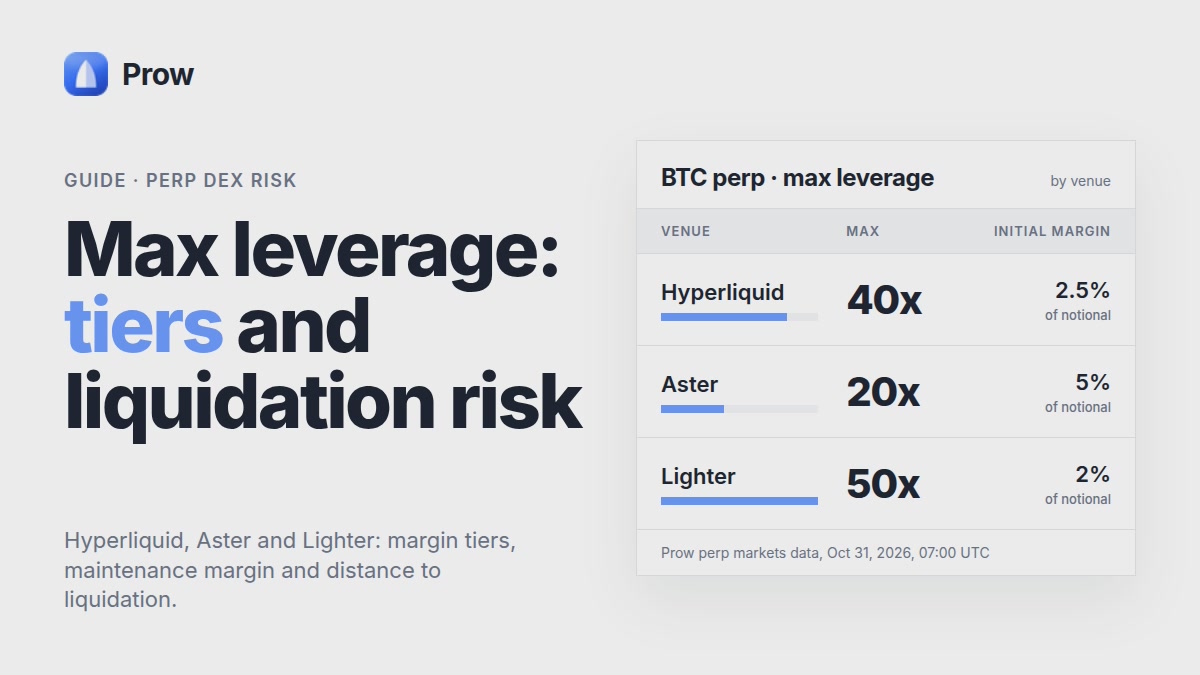
Lighter defines requirements as fractions of notional rather than as leverage numbers. Each market has an initial margin fraction, which sets max leverage (a 2% fraction equals 50x). It also has a maintenance margin fraction, which is the liquidation floor, and a close-out margin fraction used in the liquidation process.
These terms are taken from each venue's documentation, and the tables behind them change. Check the venue's current tier or bracket table for the exact market before you size a position.
Worked example: same market, two sizes
The numbers below are illustrative. They show how tiering works and are not any venue's current table. Suppose a market has two tiers:
| Position notional | Max leverage | Minimum initial margin |
|---|---|---|
| Up to $1,000,000 | 20x | 5% |
| Above $1,000,000 | 10x | 10% |
- A $200,000 position can open at up to 20x with $10,000 of margin.
- A $2,000,000 position falls into the second tier. The most it can use is 10x, so it needs at least $200,000 of margin, not $100,000.
The headline "20x" on the market page only applies to the smaller size.
Max leverage on Hyperliquid, Aster and Lighter: where to read it
The same asset often has different caps on each venue, and venues revise caps without much notice. Any figure printed in an article ages quickly. Live per-market values for all three venues are on the Prow perp markets page, with dedicated views for ETH perp markets and BTC. Public market data there updates about every minute.
When you note a cap, record three things:
- the market and venue
- the max leverage shown
- the date and time (UTC) you read it
A higher cap is not a better venue. Maker and taker fees, builder fees, order book depth, open interest and the liquidation process all differ. Compare them on the perp DEX fees page and in the Hyperliquid vs Aster vs Lighter comparison.
Maintenance margin: where liquidation begins
- Initial margin is what you need to open a position.
- Maintenance margin is the floor. When your margin, after unrealized losses, falls below it, liquidation starts.
The venues link the two differently:
- Hyperliquid: maintenance margin is half the initial margin at the market's max leverage.
- Aster: each notional bracket lists its own maintenance margin rate.
- Lighter: the maintenance margin fraction is set per market, alongside the initial fraction.
Do not assume one venue's rule applies to the others.
Near max leverage, the gap between what you posted and the maintenance floor is small. Under Hyperliquid's rule, a 40x position posts 2.5% and is liquidated near 1.25%. That leaves roughly a 1.25% adverse move.
Leverage vs liquidation distance, in numbers
The table shows an isolated long on a market capped at 40x. It uses Hyperliquid's documented rule, so maintenance margin is 1.25% of notional. Distance is the adverse price move from entry to the liquidation price, before fees and funding.
| Leverage | Initial margin | Approx. move to liquidation |
|---|---|---|
| 3x | 33.3% | ~32.5% |
| 10x | 10% | ~8.9% |
| 25x | 4% | ~2.8% |
| 40x (max) | 2.5% | ~1.3% |
The distance shrinks much faster than leverage grows. Going from 10x to 40x multiplies size by 4, but it cuts the room to liquidation by about 7 times.
Two factors move the liquidation price closer over time:
- Fees. Entry fees are taken from your balance. Exit fees will be charged too.
- Funding. When you are on the paying side, each payment reduces your margin. The current rates per hour and APR are on the funding rates page.
For the exact formula, examples for shorts, and how cross margin changes the result, read the guide to liquidation price on Hyperliquid and Aster.
The leverage you choose matters more than the cap
The cap only sets the upper bound. Your actual risk comes from two things: position size relative to your account, and where your stop sits relative to the liquidation price.
- A stop that sits beyond the liquidation price does not protect you. The position is liquidated first.
- In isolated margin, the leverage setting and the margin you assign determine the liquidation price for that position.
- In cross margin, the liquidation price depends on total account equity and on your other positions, not on the leverage slider alone. A loss on one position can bring another closer to liquidation.
If you hold positions on more than one venue, each has its own margin and is liquidated on its own venue. The guide to trading perps on multiple DEXs in one app covers this for hedges.
A pre-trade leverage checklist (no signals)
- Check the current max for this market and for your size. Look at the tier or bracket table if your notional is large, and write down when you checked it.
- Read the liquidation price before you submit. Calculate the distance in percent and compare it with your stop.
- Add the costs. Include round-trip fees on the full notional, plus the funding you expect to pay while the position is open.
- Choose isolated or cross deliberately. Do not leave margin mode on whatever default the venue or app shows.
- Size so that liquidation is not your exit plan.
Setting and watching leverage in Prow
In Prow you pick the venue for each order, then set leverage and margin mode for it. The limits are the venue's own. Prow does not raise or lower them.
- Funds stay with the venue. Your funds stay in your account on Hyperliquid, Aster or Lighter. Prow does not hold them.
- The trading key stays on your device. It is created in your browser and confirmed once with your wallet. It is stored encrypted on your device and is not sent to Prow's servers. It expires after 180 days, and you can revoke it at any time.
- One list for all venues. Positions from all three venues appear in one list, with the venue shown on every row.
- Liquidation alerts. Prow sends alerts as positions approach liquidation. These alerts are fully supported on Hyperliquid. Check Prow Docs for current support on Aster and Lighter.
For step-by-step first trades on each venue, see the perp trading guides.
Frequently asked questions
How do I convert a margin fraction into a leverage number?
Divide 1 by the fraction. A 5% initial margin fraction equals 20x, and 10% equals 10x. The same works in reverse: 25x means at least 4% of the notional must be posted as margin.
Does cross margin let me go above a market's max leverage?
No. The per-market cap still limits each position. Cross margin only changes where losses are drawn from. It uses the shared account balance, so one losing position can consume margin that other positions rely on.
Why does the same coin have a different max leverage on Hyperliquid, Aster and Lighter?
Each venue sets its own risk parameters per market, based on its own order book depth, open interest and liquidation process. Caps can differ for the same asset and can change, so compare them with a date and time attached.
Can fees and funding move my liquidation price?
Yes. Trading fees are charged on the full notional, and funding payments can reduce the margin backing a position over time. Less margin means a smaller adverse move is needed to reach maintenance margin, especially at high leverage.
If I pick a lower leverage, can I still lose my whole margin?
Yes. Lower leverage widens the distance to liquidation but does not remove it. Fast moves, gaps and thin liquidity can still lead to liquidation and the loss of the full margin on the position, or the whole balance in cross margin.