Maker Taker Fee Calculator for Perps: Round-Trip Cost
Estimate a perp trade's full cost: maker/taker fees on notional, builder fee and funding, with a break-even formula. Examples use illustrative rates.
Published 8 min read
On this page
- Maker and taker fees in one minute
- How to read a perp DEX fee table
- Find your tier
- Separate the venue fee from the builder fee
- Convert units
- The formula for round-trip cost
- Worked example: the same trade on two venues
- Four fill scenarios
- Add funding
- Leverage does not change fees, but it changes what they cost you
- Fees vs funding: when a funding trade pays
- Mistakes that inflate cost
- Run the numbers in Prow
- Frequently asked questions
- Is slippage included when I calculate perp trading fees?
- How are fees charged if my order fills in parts or I close a position in steps?
- Do leverage or liquidation change the fee rate I pay?
- How often should I recheck maker and taker rates?
- Does Prow hold my funds or add a fee when I trade through it?
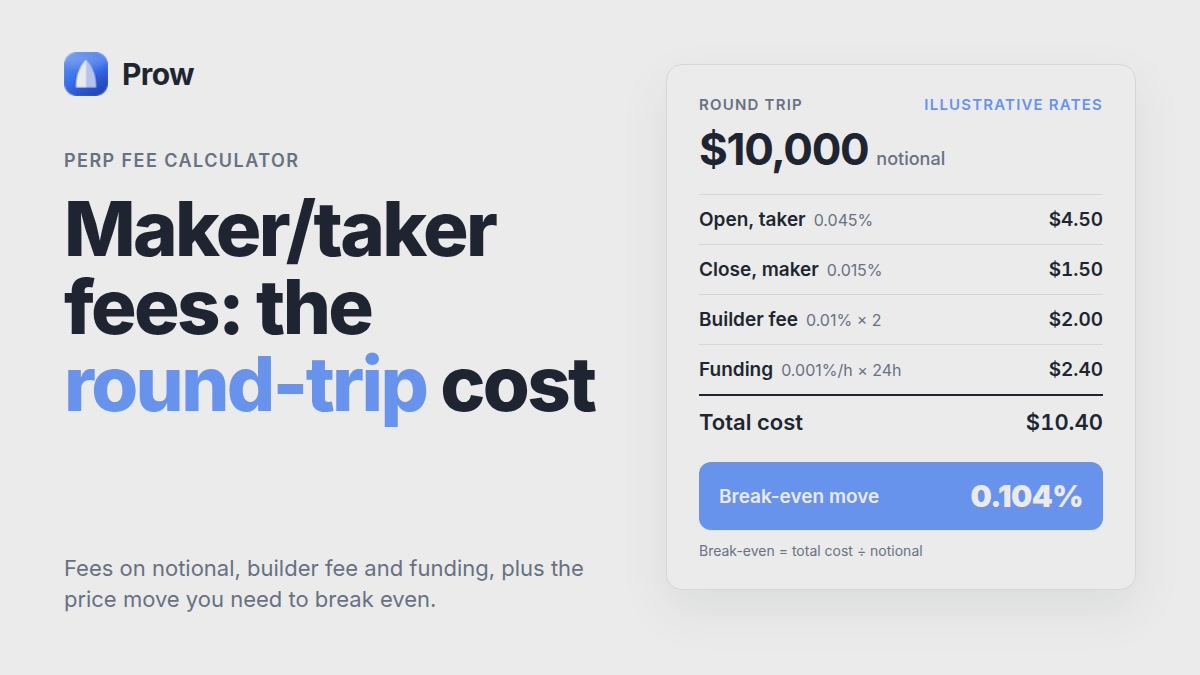
To estimate the real cost of a perp trade, add four parts: the entry fee, the exit fee, any builder fee charged by the front end on both legs, and the funding paid or received while the position is open. Every fee is charged on notional (position size), not on your margin. For example, a $10,000 position that pays 0.05% to enter and 0.05% to exit costs $10 in fees. If you posted $500 of margin at 20x, that $10 is 2% of your deposit. This guide works like a maker taker fee calculator for perps. It walks through the formula step by step so you can repeat it on Hyperliquid, Aster or Lighter with current rates.
Maker and taker fees in one minute
- Maker: your limit order rests on the order book and adds liquidity. Someone else fills against it later.
- Taker: your order fills immediately against orders already on the book. Market orders are always taker.
- Post-only is the only way to guarantee a maker fill. A normal limit order priced through the spread fills at once and pays the taker rate.
- Venues publish a base-tier rate and lower rates for higher volume. Some venues have zero or even negative maker rates on certain tiers. Always quote a rate with its source and the date you read it.
How to read a perp DEX fee table
Find your tier
Most fee tables rank accounts by rolling trading volume over a fixed window, such as 14 or 30 days. Each venue's docs state its window. If your volume dropped last month, you may have fallen back to base-tier rates without noticing.
Separate the venue fee from the builder fee
The venue fee goes to the exchange. A builder fee is an extra charge some front ends add to each order you send through them. It appears as a separate line, and it applies to entry and exit. Prow charges 0% through the end of 2026. Venue fees still apply.
Convert units
Rates are a percentage of notional and are often shown in basis points.
- 1 bp = 0.01%
- 4.5 bps = 0.045% = $4.50 per $10,000 of notional
The formula for round-trip cost
Use three lines.
- Fees = notional × (entry rate + exit rate + builder fee × 2)
- Funding = notional × hourly funding rate × hours held. Whether it is a cost or income depends on your side and the sign of the rate. When the rate is positive, longs pay shorts. When it is negative, shorts pay longs.
- Break-even move = (fees + funding paid) ÷ notional. This is the price change you need before PnL turns positive.
Venues settle funding at different intervals. Convert every rate to per hour before you compare. The Perp funding rates: Hyperliquid, Aster, Lighter page already shows rates per hour and as APR.
Worked example: the same trade on two venues
The trade is a $10,000 long, held for 24 hours, with no builder fee. Both venues use illustrative rates.
| Maker | Taker | |
|---|---|---|
| Venue A (illustrative) | 0.02% | 0.05% |
| Venue B (illustrative) | 0.00% | 0.04% |
Four fill scenarios
| Entry / exit | Venue A | Venue B |
|---|---|---|
| Taker / taker | 0.10% = $10 | 0.08% = $8 |
| Maker / taker | 0.07% = $7 | 0.04% = $4 |
| Taker / maker | 0.07% = $7 | 0.04% = $4 |
| Maker / maker | 0.04% = $4 | 0.00% = $0 |
Maker-in, taker-out is a common real pattern. You enter with a resting limit order, then exit with a market order or a stop-loss.
Add funding
Now assume, again for illustration, that the same coin's funding is +0.001% per hour on Venue A and +0.003% per hour on Venue B. A long pays in both cases.
- Venue A: $10,000 × 0.00001 × 24 = $2.40
- Venue B: $10,000 × 0.00003 × 24 = $7.20
Here is the taker/taker total:
- Venue A: $10 + $2.40 = $12.40, break-even move 0.124%
- Venue B: $8 + $7.20 = $15.20, break-even move 0.152%
Venue B had the lower fees, but it costs more once funding is included. Over a few minutes the fee gap dominates. Over a few days the funding gap can dominate.
Leverage does not change fees, but it changes what they cost you
The fee is the same at any leverage for the same notional. What changes is how large that fee is compared with your deposit. Here is the Venue A taker/taker cost of $10 on a $10,000 position:
| Leverage | Margin | Round-trip fee as % of margin |
|---|---|---|
| 1x | $10,000 | 0.1% |
| 5x | $2,000 | 0.5% |
| 20x | $500 | 2.0% |
Higher leverage also moves the liquidation price closer to entry. At 20x, a move against you of roughly 5%, minus the maintenance margin buffer, can liquidate the position. That means the whole margin can be lost long before fees are covered. Fee math does not reduce this risk.
Fees vs funding: when a funding trade pays
A cross-venue funding trade, or a spot-perp cash and carry trade, has two legs. Each leg is opened and closed, so you pay four fee legs.
Take $10,000 per leg with the illustrative rates above.
- All taker: 0.05% + 0.05% (Venue A) + 0.04% + 0.04% (Venue B) = 0.18% = $18
- All maker: 0.02% + 0.02% + 0% + 0% = 0.04% = $4
Suppose the net funding you collect, after the paying leg is subtracted from the receiving leg, is 0.002% per hour. That is $0.20 per hour on $10,000.
- Hours to cover taker fees: $18 ÷ $0.20 = 90 hours
- Hours to cover maker fees: $4 ÷ $0.20 = 20 hours
The calculation assumes the funding spread stays the same for the whole period. In practice it changes every interval and can flip negative, while fees are paid no matter what happens. Each leg also carries its own liquidation risk. The guide Is delta neutral risk-free? walks through these failure cases with numbers. Funding rate arbitrage between Hyperliquid and Aster covers the trade setup.
Mistakes that inflate cost
- Assuming a limit order is maker. If it crossed the spread, it paid taker. Use post-only when the maker rate matters to your math.
- Leaving out the exit leg or the builder fee. A one-way estimate understates cost by about half.
- Using stale rates or a lost tier. Re-check the fee table and your rolling volume before you rely on a tier discount.
- Ignoring slippage. Market orders and stop-loss exits fill as taker and can move through several price levels on a thin book. That slippage is a cost on top of the fee.
- Mixing funding intervals. An 8-hour rate compared with a 1-hour rate looks eight times larger. Convert both to per hour first.
Run the numbers in Prow
- The Perp DEX fees page compares maker, taker and builder fees on Hyperliquid, Aster and Lighter.
- The funding rates page shows live funding per hour and as APR, updated about every minute, with the gap between venues.
- When you place an order in Prow, you choose the venue. Your funds stay in your account on that venue, and Prow does not hold them. The trading key is created in your browser, stored encrypted on your device, expires after 180 days, and can be revoked at any time.
More walkthroughs are in the perp trading guides.
Frequently asked questions
Is slippage included when I calculate perp trading fees?
No. Fee tables only show the maker and taker rates. A market order can also cost the bid-ask spread plus slippage when it fills across several price levels. That cost depends on order book depth for your size, so check liquidity separately before you compare venues on fees alone.
How are fees charged if my order fills in parts or I close a position in steps?
Each fill is charged on its own notional at the rate that applies to it. One order can partly rest on the book as maker and partly fill as taker. Your total fee is the sum of all fills, so a split exit can mix rates.
Do leverage or liquidation change the fee rate I pay?
Leverage does not change the rate. The fee is based on notional, not on margin. Liquidation rules and any related charges differ by venue, so read each venue's documentation. In practice, a liquidation can cost the whole margin, which outweighs any fee saving.
How often should I recheck maker and taker rates?
Recheck them whenever you plan a trade or a strategy. Venues can change their fee schedules, and your volume tier can move as the rolling window updates. Note the source and the date each time you read a rate. The Prow fees page compares base-tier rates and builder fees across Hyperliquid, Aster and Lighter.
Does Prow hold my funds or add a fee when I trade through it?
No. Your funds stay in your own account on the venue. The trading key is created in your browser, stored encrypted on your device and expires after 180 days. You can revoke it at any time. Prow charges a 0% builder fee through the end of 2026. Venue fees and funding still apply.