Funding Rate APR Calculator: Hourly to APR and Back | Prow
Convert hourly funding to APR and back: rate × 8,760, then notional × rate × hours held. Worked examples, leverage effect and why APR is not a forecast.
Published 8 min read
On this page
- What the hourly funding rate actually is
- Normalise first: converting any interval to an hourly rate
- Hourly to APR: the formula and a reference table
- APR back to a real holding cost in dollars
- Worked example at a flat rate
- The same example with a changing rate
- The same cost against your margin
- Add trading fees
- Why APR can't be used as your expected cost or income
- Comparing the same coin across Hyperliquid, Aster and Lighter
- A quick checklist before reading a funding number
- FAQ
- Is a 50% funding APR what I will earn?
- Why does Prow show both per hour and APR?
- Does funding come out of my margin?
- Can funding alone liquidate a position?
- Frequently asked questions
- What is the difference between funding APR and APY?
- How do I calculate funding APR from a daily rate?
- Does a negative funding APR mean I get paid?
- Is funding included in the trading fees I see on the fee comparison?
- Who holds the funds that funding is paid from when I trade through Prow?
A funding rate APR calculator uses one formula: APR = hourly funding rate × 24 × 365, which is the hourly rate × 8,760, with no compounding. To go the other way, divide the APR by 8,760 to get the hourly rate, then multiply by your position notional and the hours you actually hold. For example, 0.0010% per hour ≈ 8.76% APR, and on $10,000 notional it costs or pays about $0.10 per hour if the rate stays flat. The APR describes the current rate scaled to a year. It is not what a position will pay or earn.
All rates in this article are arithmetic illustrations, not market data. For real per-venue figures, use the live perp funding rates for Hyperliquid, Aster and Lighter, which shows the source and update time.
What the hourly funding rate actually is
Funding is a periodic payment between the longs and shorts of a perpetual futures market. It keeps the perp price close to the spot (index) price.
- It is charged on notional, not on margin. A $10,000 position pays funding on $10,000, even if your margin is $1,000.
- Positive rate: longs pay shorts. Negative rate: shorts pay longs.
- Each venue settles on its own interval. Some markets settle every hour, others every few hours. Hyperliquid's documentation describes hourly funding payments (see our guide to how hourly funding works on Hyperliquid). Intervals can also differ by market on one venue, so check each venue's docs and note the date you checked.
- Funding moves between traders. It is not a fee paid to the venue or to Prow.
Normalise first: converting any interval to an hourly rate
Before you annualise anything, put every rate on the same unit.
Hourly rate = interval rate ÷ hours in the interval
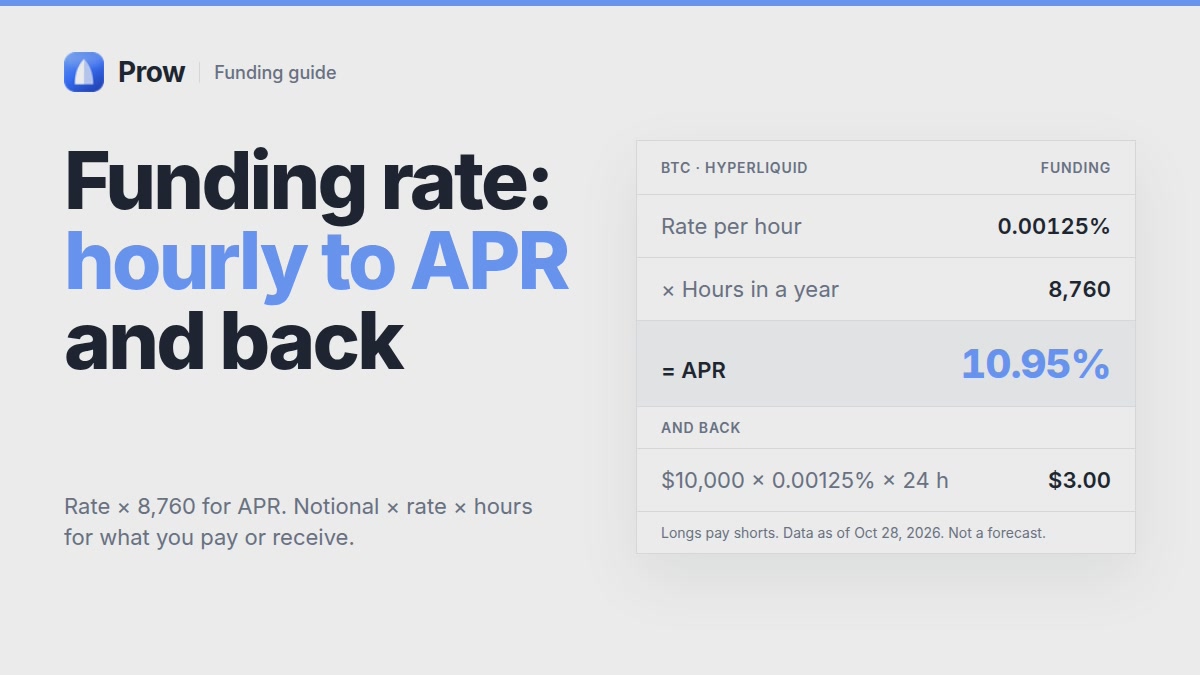
- 0.01% per 8 hours ÷ 8 = 0.00125% per hour
- 0.01% per 4 hours ÷ 4 = 0.0025% per hour
- 0.01% per 1 hour = 0.01% per hour
The three quotes all read "0.01%", but the hourly rates differ by up to 8×. If you set an 8-hour figure next to a 1-hour figure without converting, you either inflate one venue's funding eightfold or hide a real difference.
The same error carries into APR. Treat 0.01% per 8h as if it were hourly and you get 87.6% APR. The correct figure is 0.00125% × 8,760 = 10.95% APR.
This is why the Prow funding-rates page shows every venue per hour first, and APR second.
Hourly to APR: the formula and a reference table
APR = hourly rate × 8,760
This is simple annualisation. It does not compound, because funding settles in your venue account and does not automatically grow your position.
| Hourly rate (example) | Per day (×24) | APR (×8,760) |
|---|---|---|
| 0.0005% | 0.012% | 4.38% |
| 0.0010% | 0.024% | 8.76% |
| 0.0025% | 0.060% | 21.90% |
| 0.0050% | 0.120% | 43.80% |
| 0.0100% | 0.240% | 87.60% |
These are arithmetic examples, not current market rates.
Two points follow from the table:
- A small hourly number becomes a large APR. 0.01% per hour looks negligible, and 87.6% APR looks dramatic. Both describe the same rate. Read both before you react to either.
- Reverse check: hourly = APR ÷ 8,760. A quoted 43.8% APR is 0.005% per hour.
APR back to a real holding cost in dollars
Traders rarely hold a position for exactly a year. What matters is the dollar amount for your actual holding time.
Funding cost = notional × hourly rate × hours held
In practice the rate changes every interval, so the real figure is a sum, hour by hour.
Worked example at a flat rate
- Notional: $10,000
- Illustrative rate: 0.0010% per hour (8.76% APR)
- Holding time: 72 hours
$10,000 × 0.00001 × 72 = $7.20, paid by longs to shorts if the rate stays positive and flat.
The same example with a changing rate
- Hours 1–24 at 0.0010%: $0.10 × 24 = $2.40
- Hours 25–48 at 0.0040%: $0.40 × 24 = $9.60
- Hours 49–72 at −0.0010%: −$0.10 × 24 = −$2.40
Total for a long: $9.60. The starting APR of 8.76% would have predicted $7.20. The sign flip in the last day reversed part of the cost.
The same cost against your margin
Now open that $10,000 position with $1,000 of margin at 10x leverage. The $7.20 is still charged on $10,000 notional, but as a share of your deposit it is 0.72% in three days, against 0.072% if the position were not leveraged.
At a flat 8.76% APR, funding over a year would equal 87.6% of the margin. Leverage does not change the rate. It changes how big the payment is relative to the money you put in.
Add trading fees
Funding is only part of the cost. Entry and exit each pay a maker or taker fee. With an illustrative 0.04% per side on $10,000, that is $4 to open and $4 to close: $8, more than the $7.20 of funding in the flat example. Compare real rates per venue in perp DEX fees: Hyperliquid vs Aster vs Lighter.
Why APR can't be used as your expected cost or income
APR is a unit for scale, not a forecast.
- It assumes today's rate holds for a year. Funding is recalculated every interval and can change sign.
- Short spikes annualise into extreme numbers. An illustrative 0.05% per hour shows as 438% APR. If it lasts three hours on $10,000 notional, it moves $15, not $43,800.
- Averages say more than a single print, but still don't predict. A 30-day history smooths spikes, yet the next 30 days can differ.
- It ignores everything else. APR leaves out trading fees, price drift between the two legs of a hedge, one-sided fills and liquidation. Funding or delta-neutral setups can lose money even when the funding sign is in their favour. See how hedged trades lose money for worked cases.
Comparing the same coin across Hyperliquid, Aster and Lighter
- Use one unit, one coin, one timestamp. Per hour, the same market, the same moment. Rates from different times are not comparable.
- Read the gap together with fees, open interest and liquidity. A wide funding gap on a thin market can disappear in slippage.
- A gap is not income. Both legs pay trading fees, and each leg has its own margin and can be liquidated on its own venue, even if the combined position is hedged.
- Venue formulas and caps differ. How the rate is computed, how often it settles and how high it can go are set by each venue. Cite the venue's documentation and the date you checked it.
For single coins, the BTC funding rate on Hyperliquid, Aster and Lighter page shows the same comparison per hour with history.
A quick checklist before reading a funding number
- Which unit is it: per hour, per interval or APR? If per interval, how many hours?
- Which sign, and who pays whom? Positive: longs pay shorts.
- Is it a current print or a historical average? From what source and what date?
- What is it in dollars on my notional, for my real holding time, after entry and exit fees?
- What is it as a share of my margin at the leverage I use?
FAQ
Is a 50% funding APR what I will earn?
No. It is the current rate multiplied by 8,760. The rate can fall, rise or turn negative at the next interval, and APR does not include fees or the risk of liquidation.
Why does Prow show both per hour and APR?
Per hour, so venues with different settlement intervals can be compared directly. APR, so the size of a rate is easier to judge. The data updates about every minute.
Does funding come out of my margin?
Yes. Funding settles in your account on the venue, which is where your funds stay. Prow does not hold them. Your trading key is stored encrypted on your device.
Can funding alone liquidate a position?
It can contribute. Paid funding reduces margin over time, which moves the liquidation price closer. On a long hold at high leverage, check the liquidation price regularly. Leveraged trading can lose the whole deposit.
Frequently asked questions
What is the difference between funding APR and APY?
APR is the hourly rate multiplied by 8,760 with no compounding. APY would assume each payment is reinvested and earns funding too. Funding settles in your venue account and does not automatically enlarge your position, so simple APR is the more accurate scaling for perps.
How do I calculate funding APR from a daily rate?
Multiply the daily rate by 365. For example, 0.024% per day × 365 = 8.76% APR. To get the hourly rate, divide the daily rate by 24. For 0.024% per day, that is 0.001% per hour.
Does a negative funding APR mean I get paid?
It depends on your side. A negative rate means shorts pay longs, so a long position receives funding and a short pays it. The sign can change at any interval, so a receiving position can start paying later.
Is funding included in the trading fees I see on the fee comparison?
No. Maker and taker fees are charged by the venue when an order fills. Funding is a separate payment between longs and shorts while a position is open. To estimate total holding cost, add both together, along with any builder fee.
Who holds the funds that funding is paid from when I trade through Prow?
Funding is credited to or debited from your margin in your account on the venue itself: Hyperliquid, Aster or Lighter. Prow does not hold funds. The trading key is stored encrypted on your device, and you can revoke it at any time.