Lighter Perp DEX: Funding, Accounts, Markets and Risks
Lighter perp DEX reference: hourly peer-to-peer funding, Standard/Plus/Premium accounts, markets, ZK rollup custody and risks. Data as of 9 Nov 2026.
Published 12 min read
On this page
- Key takeaways
- What Lighter is and where your funds sit
- Account types and fee terms
- Markets: what to check, especially beyond crypto
- Leverage, margin and liquidation
- Funding on Lighter
- Lighter next to Hyperliquid and Aster: funding facts
- Trading Lighter through Prow: funds and keys
- What to check before the first trade
- Sources
- Frequently asked questions
- What is Lighter perp DEX and how does it work?
- Does Lighter charge trading fees for maker and taker orders?
- How is funding calculated on Lighter perps and how often is it paid?
- How do I deposit and withdraw funds on a Lighter account?
- Is Lighter non-custodial and what are the risks of trading on it?
Lighter is a perp DEX where you trade perpetual futures from your own account. Funding is paid peer-to-peer every hour, and Lighter takes no fee on it. This reference collects what Lighter's documentation states as of 9 November 2026 and marks what it does not state. Fee details sit in a separate guide. Leverage, maintenance margin and the market list should be checked on the venue before each trade. Leveraged perps can lose the whole deposit.
Key takeaways
- Lighter pays funding at each hour mark, according to Lighter's funding docs (checked 9 November 2026).
- Lighter's docs state funding is "fully peer-to-peer with no fees taken by the exchange": one side pays, the other receives.
- On Lighter, a positive funding rate means longs pay shorts, and the premium part is spread over 8 hours.
- Lighter has Standard, Plus and Premium account types with different fee and latency terms, covered in the Lighter fees guide.
- When you trade Lighter through Prow, funds stay in your Lighter account and the trading key stays encrypted on your device.
What Lighter is and where your funds sit
Lighter is a decentralized perp exchange built as a zero-knowledge (ZK) rollup on Ethereum, per Lighter's documentation. Orders are matched off-chain by Lighter's sequencer. The resulting state, including balances, trades and liquidations, is proven with ZK proofs and committed to Ethereum. Your margin sits in your own Lighter account inside that rollup, not with any app you trade through.
What the docs describe, in plain terms:
- Collateral: USDC. Margin, PnL and funding are settled in USDC.
- Deposits: USDC goes from Ethereum, or a supported network, into the Lighter rollup and is credited to your account.
- Withdrawals: Lighter describes two paths. The standard path settles back to Ethereum through the rollup and takes longer. A fast path returns funds sooner and may carry a fee. Exact timings and fees change, so check them on Lighter before you rely on them.
- Escape hatch: the rollup design includes a forced-exit mechanism. If the operator stopped processing requests, users could withdraw against the state already committed on Ethereum.
Step-by-step deposit and withdrawal screens are in the guide on how to trade perps on Lighter. This article does not give withdrawal times, because we could not confirm current figures with a date.
What non-custodial means in practice:
- Your collateral is held in your Lighter account.
- An app like Prow sends orders with a trading key. That key can trade but cannot withdraw.
- Non-custody does not protect you from liquidation, funding costs or price gaps. It only defines who can move the funds.
- A rollup and an escape hatch reduce reliance on the operator. They do not remove smart contract, bridge or operational risk.
Account types and fee terms
Lighter has three account types: Standard, Plus and Premium. Each has its own maker and taker terms. Standard charges no trading fee, but orders on it pass through added latency.
| Account | Maker fee | Taker fee | Latency |
|---|---|---|---|
| Standard | 0% | 0% | Added delay on maker, cancel and taker orders |
| Plus | See guide | See guide | See guide |
| Premium | 0.002% | 0.02% | Lower than Standard |
Source: Lighter account-type documentation, as published when Premium accounts launched in 2025. Lighter can change these terms, and we could not confirm the current millisecond values or the Plus figures with a date for this article. For those, check the live table on Lighter fees on the comparison page. The Lighter fees guide covers switching tiers and LIT staking.
The latency trade-off in plain words: on the zero-fee tier, your orders reach the book a little later than on paid tiers. For a resting limit order this may not matter. For a market order in a fast move, it can mean a worse fill. That cost does not show up as a fee line.
A simple check on Premium: a $10,000 taker fill at 0.02% costs $2 in venue fees. A round trip, with taker on both sides, costs $4, before any app fee and before funding.
The fee stack on one trade:
- the venue's maker or taker fee for your tier;
- any builder or integrator fee an app adds, approved once by your wallet;
- Prow's own fee: 0% through the end of 2026. Venue fees still apply.
Markets: what to check, especially beyond crypto
Lighter adds and removes markets, so this article does not give a count we cannot date. The live list is on Lighter perp markets. It shows the count, max leverage, 24h volume and open interest for each market, and Prow updates it about every minute. Before you trade, write down three numbers for the market and the time you read them:
- max leverage;
- open interest;
- 24h volume.
These tell you how much room the venue allows and how much liquidity sits behind the price.
One point holds for every Lighter market: margin and liquidation are measured against the mark price, not the last traded price. The mark price is derived from external reference prices. This limits how far a thin book or one large print can move your liquidation level on its own.
If a market tracks a stock, index, commodity or currency, ask three questions before you size a position:
- What price source does the perp reference?
- What happens to that reference when the underlying market is closed?
- Can the perp gap when the underlying reopens, and how does that affect funding?
The answers can differ by market. Read the market's own spec on Lighter, and treat a closed underlying as a period when the perp can move without a live reference.
Liquidity differs a lot between markets. A thin order book makes slippage larger and liquidation fills worse. Compare depth and open interest first. The BTC and ETH pages on Prow show the same market across all three venues.
Leverage, margin and liquidation
Lighter sets margin per market with fractions rather than a single leverage label. Its docs describe three of them:
- Initial margin fraction (IMF): the margin needed to open a position. Max leverage = 1 / IMF. An IMF of 2% means 50x.
- Maintenance margin fraction (MMF): the level below which the position becomes liquidatable.
- Close-out margin fraction: a lower level at which the position can be fully closed out.
All three are measured against the mark price. Read them in the BTC or ETH market spec on Lighter on the day you trade. They differ by market and can change. Max leverage is a ceiling, not a setting.
Isolated vs cross. With isolated margin, only the margin assigned to that position counts. With cross margin, your whole account equity backs all open positions. The account becomes liquidatable when total equity falls below the sum of their maintenance requirements. A loss on one market then eats margin that other positions rely on.
Isolated long, approximate liquidation price:
- liquidation price ≈ entry × (1 − 1 / leverage) / (1 − MMF)
For a short, use entry × (1 + 1 / leverage) / (1 + MMF). Plug in the MMF from the market spec, not a figure from another venue.
Two things move the real number away from this estimate:
- fees and funding paid out of the position's margin;
- mark price differing from the last trade.
Always compare your own math with the liquidation price Lighter shows on the order. For the full method, see the Prow docs.
Funding on Lighter
Lighter pays funding every hour. Per Lighter's funding docs, "Funding payments occur at each hour mark" and "When the funding rate is positive, users with long positions pay a funding fee to users with short positions." A negative rate means shorts pay longs. Funding moves between traders on the two sides.
How the rate is built, in plain words:
- Premium: the gap between the perp price and its reference price, sampled through the hour. When the perp trades above the reference, the premium is positive and longs pay.
- Spreading it out: the docs say: "Dividing the 1-hour premium by 8 ensures that funding payments for the premium are distributed over 8 hours." A one-hour spike is paid off over eight hourly payments instead of at once.
For the interest component and any clamp on the hourly rate, read the full formula on the docs page above. We do not restate parameters here that we could not confirm with a date.
To convert:
- hourly rate × 8,760 = APR;
- dollars = notional × rate × hours.
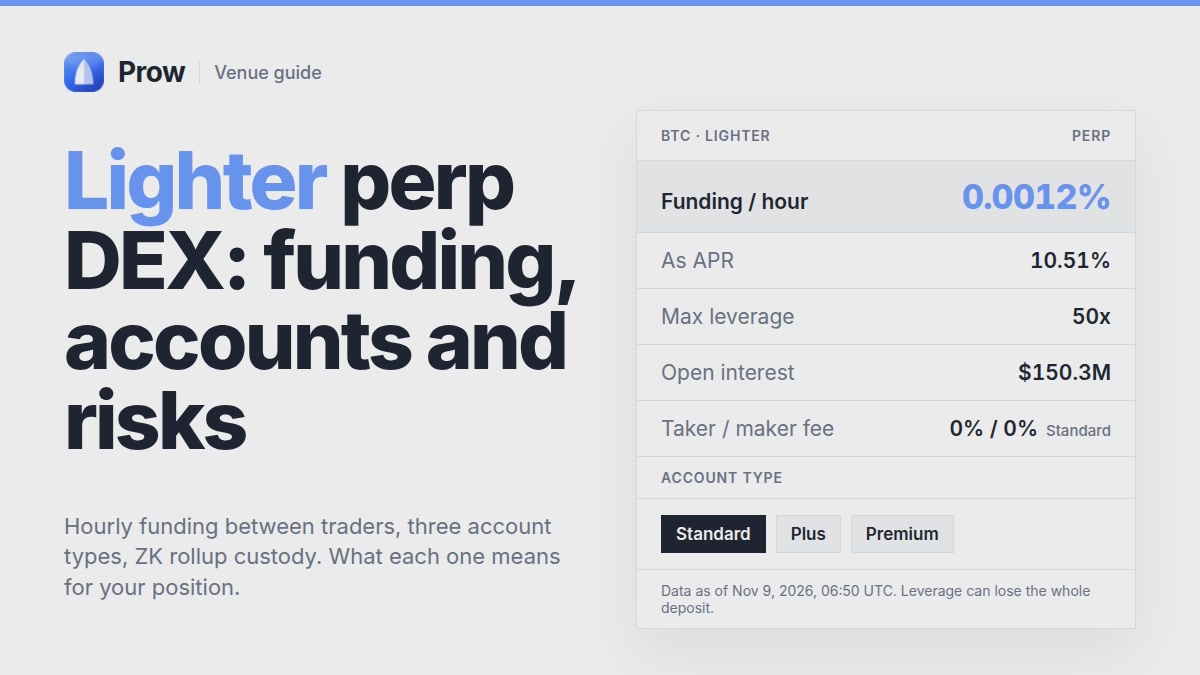
A worked example, not a current rate. On 31 October 2026, 06:00 UTC, Prow's funding page showed BTC on Lighter at 0.0012% an hour (10.51% APR). For a $10,000 position that is $0.12 an hour and $2.88 a day, if the rate stayed flat. It does not stay flat. Because the premium is re-measured every hour, the rate follows positioning. It can change within hours, and the sign can flip.
Check the current BTC and ETH rates on Perp funding rates at the time you trade, not a figure from an article.
Lighter next to Hyperliquid and Aster: funding facts
All three venues pay funding, but the interval and documented parameters differ. This table uses only what each venue's docs state, checked 9 November 2026.
| Lighter | Hyperliquid | Aster | |
|---|---|---|---|
| Interval | Hourly | Hourly | Default 8 hours, may change |
| Who receives funding | Traders on the other side | Traders on the other side | Traders on the other side |
| Interest component | See Lighter docs | 0.00125%/hour | 0.01% (0% on BNBUSDT) |
| Floor and cap | See Lighter docs | Capped, see docs | Can be adjusted by Aster |
Sources: Hyperliquid funding docs describe a capped hourly rate paid between traders. Aster's funding rate docs note Aster "reserves the right to adjust the funding rate floor, cap, and the funding interval". Aster also warns that "fees may be taken from your position margin, potentially impacting your liquidation price."
Same market, same moment. BTC on Prow's funding page, 31 October 2026, 06:00 UTC, shown as an hourly rate:
| Venue | Hourly rate | APR |
|---|---|---|
| Hyperliquid | 0.0013% | 10.95% |
| Aster | 0.0013% | 10.95% |
| Lighter | 0.0012% | 10.51% |
On that reading the gap was 0.0001% an hour. That is $0.01 an hour on $10,000, small next to taker fees on a round trip. Aster settles every 8 hours by default, so its hourly figure is a rate shown per hour, not an hourly payment. This is one snapshot. It says nothing about other days.
This is not a ranking. Total cost depends on tier, maker/taker mix, liquidity and funding direction. See the three-venue comparison.
Trading Lighter through Prow: funds and keys
In Prow, Lighter is one of three venues, and you choose the venue for each order. Your funds stay in your Lighter account, and Prow does not hold them.
How the trading key works:
- Your browser creates it.
- Your wallet confirms it once. No funds move.
- It is stored encrypted on your device and never sent to Prow's servers.
- It expires in 180 days.
- You can revoke it at any time.
What you get for Lighter in Prow:
- Your Lighter positions and orders appear in one list with Hyperliquid and Aster, with the venue on every row.
- Lighter funding, fees and market data appear in the free tools.
What is not available for Lighter:
- Trading bots (funding, DCA, grid) run on Hyperliquid and Aster only.
- Spot trading is on Hyperliquid and Aster only.
- Liquidation alerts are fully supported on Hyperliquid. Check the Docs for current Lighter coverage.
Each position keeps its own margin and can be liquidated on its own venue.
What to check before the first trade
Check five things before your first order on Lighter, because each one can change the cost or the risk of the trade.
- Account tier. Check your tier's fee and latency terms on the day you trade.
- Market liquidity. Look at depth, open interest and volume for the specific market. For non-crypto markets, also check what the price tracks when the underlying market is closed.
- Funding. Note the hourly rate and its sign, and convert it to dollars for your planned holding time.
- Leverage and margin. Pick the margin mode and leverage, then read the liquidation price Lighter shows. Do not rely on a leverage label.
- Exit plan for the key. Know where to revoke the key and when it expires.
If you are new to the venue, start with the guide on how to trade perps on Lighter. Leveraged trading can lose the entire deposit. Nothing in this article is a trade recommendation.
Sources
- Funding | Lighter Docs, Lighter
- Funding | Hyperliquid Docs, Hyperliquid
- Funding Rate | Aster, Aster
Frequently asked questions
What is Lighter perp DEX and how does it work?
Lighter is a decentralized perpetual futures exchange built as a ZK rollup on Ethereum, according to its documentation. Its sequencer matches orders off-chain. Balances, trades and liquidations are then proven with zero-knowledge proofs and committed to Ethereum, with USDC as collateral.
Does Lighter charge trading fees for maker and taker orders?
It depends on the account type. Per Lighter's account-type documentation published at the 2025 Premium launch, Standard charges 0% maker and 0% taker but adds latency to orders, and Premium charges 0.002% maker and 0.02% taker. Lighter can change these terms, so check the live fee comparison page before you trade.
How is funding calculated on Lighter perps and how often is it paid?
Lighter's docs (checked 9 November 2026) say funding is paid at each hour mark and is fully peer-to-peer, with no fee taken by the exchange. When the rate is positive, longs pay shorts, and the premium part of the rate is spread over 8 hours.
How do I deposit and withdraw funds on a Lighter account?
You deposit USDC from Ethereum or a supported network into the Lighter rollup, and it is credited to your account. For withdrawals, Lighter describes a slower standard path that settles back to Ethereum and a faster path that may carry a fee. Timings and fees change, so confirm them on Lighter first.
Is Lighter non-custodial and what are the risks of trading on it?
Your collateral sits in your own Lighter account, and a forced-exit mechanism lets users withdraw against state already committed to Ethereum. If you trade through Prow, the trading key is encrypted on your device and can trade but cannot withdraw. Non-custody does not protect you from liquidation, funding costs, price gaps, or smart contract and bridge risk, and a leveraged position can lose the whole deposit.