Crypto Arbitrage on Perp DEXs: 4 Types and Real Costs
Cross-venue, triangular, funding and cash-and-carry arbitrage on Hyperliquid, Aster and Lighter: fees per leg, break-even gap and liquidation risk.
Published 15 min read
On this page
- Key takeaways
- What crypto arbitrage captures, and why the visible spread shrinks after costs
- Cross-venue price arbitrage: two legs, two fees each, plus time
- Triangular arbitrage on a single venue
- Funding arbitrage between perp DEXs
- Cash-and-carry: spot long against a perp short
- Worked example: a price gap that does not survive fees
- Risks shared by every type
- How to compare the types before you commit capital
- Where to find arbitrage opportunities
- Sources
- Frequently asked questions
- What counts as a crypto arbitrage opportunity?
- Does a price gap on a scanner or screen mean I can trade it?
- Is arbitrage crypto trading risk-free?
- Does a crypto arbitrage trading bot avoid these costs?
- Why pre-fund both venue accounts for cross-venue arbitrage?
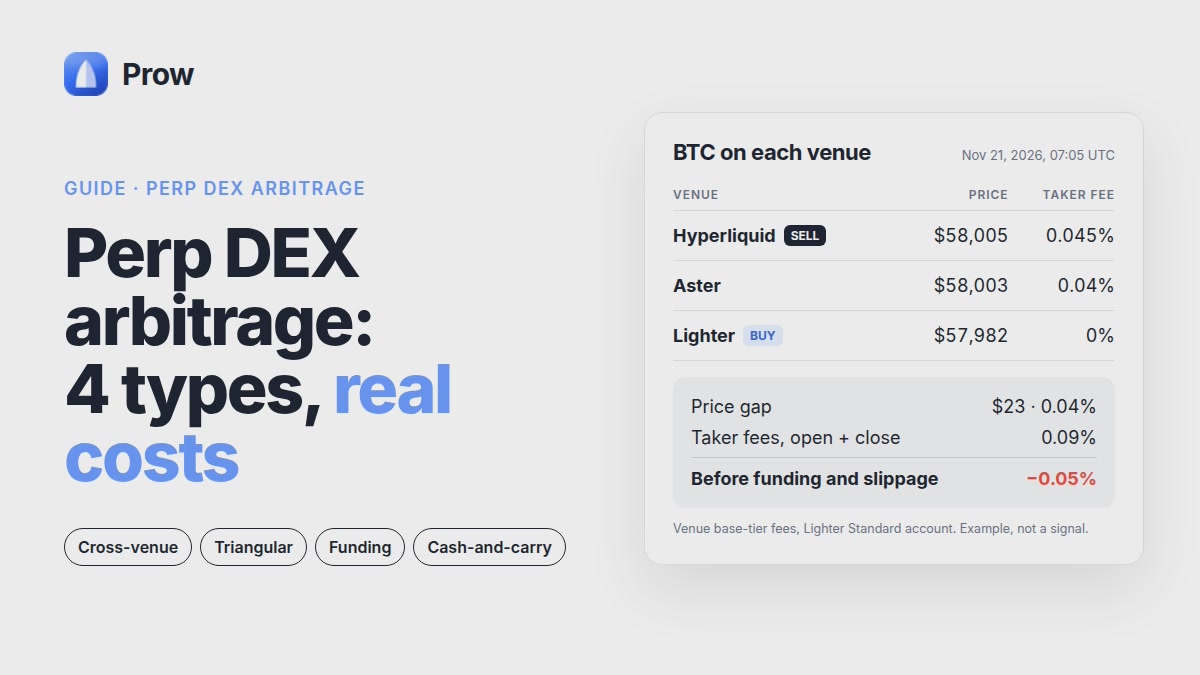
Crypto arbitrage means holding two or more linked positions at the same time to capture a gap in price or funding rate, not to bet on direction. On perp DEXs there are four main types: cross-venue price, triangular, funding and cash-and-carry. Each one pays fees on every leg. The gap you see on screen is gross. After entry and exit fees, slippage and funding, the net gap is often near zero or negative. When the legs sit on different venues, each leg also has its own margin and its own liquidation price.
Key takeaways
- Every perp trading fee is charged on notional value, not on margin. A two-leg arbitrage pays four fees: entry and exit on each leg.
- Base-tier perp fees, from each venue's fee documentation as of November 2026:
- Hyperliquid: 0.045% taker, 0.015% maker. A $10,000 position costs $4.50 to open and $4.50 to close at taker. Dwellir's example gives the same figure (Dwellir, October 7, 2026).
- Aster: 0.035% taker, 0.01% maker.
- Lighter: 0% taker and 0% maker on Standard accounts. Premium accounts are 0.02% taker and 0.002% maker.
- Fee schedules change. Check the current rate on each venue's docs or the Prow fees page before you size a trade.
- Break-even gap ≥ (sum of entry and exit fees on all legs) + expected slippage + funding paid over the hold.
- On two venues, profit on one leg does not support the other. Each leg can be liquidated on its own venue.
- Funding settles on different schedules by venue. Compare rates per hour and as APR (hourly rate × 8,760).
What crypto arbitrage captures, and why the visible spread shrinks after costs
Arbitrage captures a price or rate gap between linked positions. It does not capture market direction. The table below compares the four types with the same columns.
| Type | What is captured | Legs | Venues | Capital tied up | Cost lines | Main failure mode |
|---|---|---|---|---|---|---|
| Cross-venue price | Price gap on the same perp | 2 | 2 | Margin on both venues | 4 fees, slippage, transfer time, funding | Gap widens, one leg liquidated |
| Triangular | Misaligned cross rates | 3 | 1 | Full spot amount | 3 fees, 3 books of slippage | One pair fills, the next does not |
| Funding | Funding rate difference | 2 | 2 | Margin on both venues | 4 fees, funding sign flips | Funding flips before fees are repaid |
| Cash-and-carry | Positive funding vs spot | 2 | 1–2 | Full spot amount + perp margin | Spot and perp fees, funding, basis | Perp short liquidated on a fast rally |
The Prow fee is 0% until Dec 31, 2026. After that it is 0.025% per order on top of venue fees, with none on Lighter Standard.
Cross-venue price arbitrage: two legs, two fees each, plus time
You buy the perp where it is cheaper and short it where it is pricier. Then you close both legs when the prices converge. A typical case is the same BTC perp on Hyperliquid, Aster and Lighter.
The costs stack up quickly:
- Fees: an entry fee and an exit fee on each leg, four in total. These are usually taker fees, because both sides must fill fast. At base tiers (venue fee docs, November 2026), four taker fills on $10,000 per leg cost $18.00 on Hyperliquid–Hyperliquid pricing, $16.00 on Hyperliquid–Aster, and $9.00 on Hyperliquid–Lighter Standard. Lighter Standard charges 0%.
- Slippage: the average fill at your size, not the top-of-book price.
- Transfer time: the three venues sit on separate chains and accounts. Margin does not move between them instantly. Each move pays the network and bridge costs of the route you choose, and the venue's own deposit and withdrawal terms. A cross-venue gap can close before the margin arrives. So a common approach is to pre-fund both accounts and not move margin mid-trade.
- Funding: both legs pay or receive funding while you hold them.
This article quotes no BTC price gap without a timestamp. Gaps between the three venues change by the second. Check the dated values on the perp markets pages before you assume a gap exists at your size.
Margin buffer per leg. Each leg has its own margin and its own liquidation price on its own venue. Under Hyperliquid's BTC margin rule (maintenance 1.25% on a 40x market), an isolated leg has roughly this much room before liquidation, before fees and funding:
| Leverage | Long: drop to liquidation | Short: rally to liquidation |
|---|---|---|
| 3x | about 32.5% | about 31.7% |
| 5x | about 19.0% | about 18.5% |
| 10x | about 8.9% | about 8.6% |
These numbers are an illustration, not a recommended setting. The buffer that matters is the largest move you expect before you can top up or close the leg. Other venues use their own maintenance rules, so read the liquidation price each venue shows.
If price rallies, the short can be liquidated even while the long on the other venue shows an equal gain. You can compare live BTC prices across the three venues on the perp markets pages. Fees per venue are on the maker and taker fees per venue page. How bots decide when to enter this trade is covered in how crypto arbitrage bots work.
Triangular arbitrage on a single venue
Triangular arbitrage is three spot trades through three pairs, A→B→C→A. It works only when the cross rates are misaligned enough that you end with more of A than you started with.
Is a loop even possible? A triangle needs a cross pair, a pair between two assets that are not the venue's main quote currency. Most Hyperliquid spot pairs are quoted in USDC, such as HYPE/USDC. A loop like USDC→HYPE→X→USDC exists only if an X/HYPE pair or another cross pair is listed and has depth. Aster's spot pairs are mostly quoted in a single stablecoin, so the same limit applies. Check each venue's current spot list for cross pairs before you design a loop. If none exist, a three-pair loop on that venue is not possible. Prow offers spot trading on Hyperliquid and Aster.
Break-even example. Hyperliquid's base-tier spot fees are 0.070% taker and 0.040% maker (Hyperliquid fee docs, November 2026). Assume three taker fills on $10,000:
- Fees: 3 × $7.00 = $21.00 (0.21%)
- Slippage, assumed 0.01% per fill: 3 × $1.00 = $3.00
- Required misalignment of the cross rates: above 0.24% just to end flat
With three maker fills, fees drop to $12.00 (0.12%). The trade-off is that any leg may not fill.
What it needs:
- Three spot pairs with enough depth on one venue.
- Three fees and three order books of slippage, but no transfer between venues.
- Fast execution. These gaps are usually small and short-lived, so latency and order type decide whether a fill still pays.
Triangular arbitrage is spot only. It has no funding and no liquidation. The main risk is a partial chain. If the first pair fills and the second does not, you hold a coin you did not plan to hold, at whatever price the market gives you.
Funding arbitrage between perp DEXs
Funding arbitrage goes long where funding is lower or negative and short where it is higher. You collect the difference while the price moves on the two legs roughly offset.
Venues calculate funding differently, so normalize before you compare. Hyperliquid pays hourly: "The protocol calculates an eight-hour rate and pays one-eighth of that rate each hour" (CoinDuck, September 8, 2026). Aster's documentation divides its rate by (8/N) in its funding rate formula. Convert every rate to per hour, then multiply by 8,760 to get APR. The funding rates side by side on three DEXs page does this and timestamps each value.
Worked example: how long fees take to repay. Assume a steady gap of 0.0005% an hour on $10,000 notional per leg. That is $0.05 an hour, or 4.38% APR.
- Four taker fills at 0.045% each (about 0.18%) cost $18.00. At $0.05 an hour, that takes 360 hours, or 15 days, before the position earns anything.
- Hyperliquid–Aster at base taker rates: 2 × $4.50 + 2 × $3.50 = $16.00. That is 320 hours.
- Hyperliquid–Lighter Standard: 2 × $4.50 + $0 = $9.00. That is 180 hours.
Real gaps are often smaller. On Oct 31, 2026, 06:00 UTC, the Prow funding rates page showed BTC at 0.0013% an hour on Hyperliquid, 0.0013% on Aster and 0.0012% on Lighter. That is a gap of 0 to 0.0001% an hour. At 0.0001% an hour, $10,000 earns $0.01 an hour. Even the $9.00 Hyperliquid–Lighter Standard fee load would take 900 hours to repay, if the rate stayed flat.
It does not stay flat. This article gives no count of how often the sign flipped. A single flip reverses the income, so re-check the sign before and during the hold. The costs are four trading fees and a hold period that must pay them back, while funding can shrink or flip. Aster notes: "If your balance is insufficient, fees may be taken from your position margin, potentially impacting your liquidation price." The full Hyperliquid–Aster setup is in funding rate arbitrage between Hyperliquid and Aster.
Cash-and-carry: spot long against a perp short
Cash-and-carry means buying spot and shorting the same coin's perp. You earn funding when it is positive. Aster's docs state: "Positive funding rate: The contract price is above the Mark Price — long traders pay short traders."
The two legs carry different capital loads:
- Spot leg: fully funded, with no leverage. It cannot be liquidated.
- Perp leg: needs its own margin buffer. A thin buffer can be liquidated in a fast rally, even though the spot leg gains the same amount. That spot gain does not move to the perp margin by itself.
Worked calculation. This is arithmetic, not a forecast. Assumptions:
- $10,000 total capital on Hyperliquid, split so spot size equals short size.
- Base taker fees: 0.070% spot and 0.045% perp, paid on entry and exit (Hyperliquid fee docs, November 2026). Round trip = 0.23% of the hedged size.
- BTC funding of 0.0013% an hour (10.95% APR), from the Prow funding rates page on Oct 31, 2026, 06:00 UTC. It is held flat for 30 days (720 hours), which real funding does not do.
- Liquidation room for an isolated short, under Hyperliquid's BTC maintenance margin of 1.25%, before fees and funding.
| Short leverage | Spot | Perp margin | Hedged size | Funding, 30 days | Fees, round trip | Net | Net on $10,000 | Rally to liquidation |
|---|---|---|---|---|---|---|---|---|
| 2x | $6,667 | $3,333 | $6,667 | $62.40 | −$15.33 | $47.07 | 0.47% | about 48% |
| 3x | $7,500 | $2,500 | $7,500 | $70.20 | −$17.25 | $52.95 | 0.53% | about 32% |
| 5x | $8,333 | $1,667 | $8,333 | $78.00 | −$19.17 | $58.83 | 0.59% | about 19% |
Higher leverage on the short frees more capital for the hedge. That adds about $12 a month here. It also cuts the rally that liquidates the short from about 48% to about 19%. If funding turns negative, the short pays instead of earning, and the fees are still spent.
The costs are spot fees, perp fees and funding that can turn negative. The basis, the gap between perp and spot, can also widen before it closes. On Hyperliquid, weighted volume counts spot at double: "Weighted volume is perps volume plus 2x spot volume" (Dwellir). This can affect your fee tier. For the full walkthrough, see the cash and carry trade on Hyperliquid spot and perp.
Worked example: a price gap that does not survive fees
A 0.10% BTC perp gap on $10,000 notional per leg loses money at base taker fees on most venue pairs. This is an illustration, not a trade signal.
Fee assumptions. These are base-tier perp rates from each venue's fee documentation, as of November 2026:
- Hyperliquid: 0.045% taker ($4.50 on $10,000, matching Dwellir, October 7, 2026) and 0.015% maker.
- Aster: 0.035% taker and 0.01% maker.
- Lighter Standard: 0% taker and maker.
Check each venue's current rate on the fees page.
Baseline, Hyperliquid rates on all four taker fills:
- Gross gap: 0.10% × $10,000 = $10.00
- Fees: 4 × $4.50 = −$18.00
- Slippage, assumed 0.01% per fill: 4 × $1.00 = −$4.00
- Net before funding: −$12.00
The same trade by venue pair. Each row has one entry and one exit per leg, $10,000 per leg, and a 0.10% gap.
| Venue pair and fill type | Fees, four fills | Slippage | Net on a 0.10% gap | Break-even gap |
|---|---|---|---|---|
| Hyperliquid–Hyperliquid rates, taker | $18.00 | $4.00 | −$12.00 | 0.22% |
| Hyperliquid–Aster, taker | $16.00 | $4.00 | −$10.00 | 0.20% |
| Hyperliquid–Lighter Standard, taker | $9.00 | $4.00 | −$3.00 | 0.13% |
| Aster–Lighter Standard, taker | $7.00 | $4.00 | −$1.00 | 0.11% |
| Hyperliquid–Aster, maker | $5.00 | $0 assumed | +$5.00 | 0.05% |
| Hyperliquid–Lighter Standard, maker | $3.00 | $0 assumed | +$7.00 | 0.03% |
The break-even rule is:
Required gap ≥ (entry fee + exit fee) on each leg + slippage + funding paid over the hold
The maker rows look better only on paper. A resting order may fill on one venue and not the other, which leaves one unhedged leg. Lighter Standard's zero fee comes with its own execution terms, so read Lighter's docs before you assume the same fill speed as a Premium account. As CoinDuck notes, "A trader should calculate entry and exit executions separately when estimating a round trip."
The Prow fee is 0% until Dec 31, 2026. After that it adds 0.025% per order, none on Lighter Standard. From 2027, the four-fill Hyperliquid–Aster taker row would carry another $10.00, and its break-even would rise to 0.30%.
Risks shared by every type
Every arbitrage type can lose money, even when it is hedged on paper.
- Leg risk: one order fills and the other does not. You now hold a directional position.
- Liquidation on one side: profit on a long on one venue does not support a short on another. Each leg needs its own margin.
- Funding flips and basis drift: both can turn a positive carry negative over the hold.
- Venue risk: in Prow, funds stay in each venue account and Prow does not hold them. The trading key is created in the browser, stored encrypted on the device and expires in 180 days. You can revoke it at any time. None of this removes smart-contract, oracle or venue outage risk.
How to compare the types before you commit capital
Compare the types by your access, capital and costs. No type is best by default.
Minimum gap at base tiers. These figures come from the worked example above. They assume $10,000 per leg, four fills and 0.01% slippage per taker fill, before funding and before the Prow fee that starts in 2027:
| Venue pair | All taker | All maker (fill risk) |
|---|---|---|
| Hyperliquid–Hyperliquid rates | 0.22% | 0.06% |
| Hyperliquid–Aster | 0.20% | 0.05% |
| Hyperliquid–Lighter Standard | 0.13% | 0.03% |
| Aster–Lighter Standard | 0.11% | 0.02% |
For a funding trade, divide the same fee load by the hourly gap in dollars to get the hours needed to break even.
Use this checklist:
- Which venues can you legally access from your country?
- How much capital can you place per leg, with a margin buffer on each perp leg? At Hyperliquid's BTC maintenance rule, 5x leaves about 19% of room and 10x about 9%.
- What is your fee tier? Hyperliquid sets tiers by rolling 14-day weighted volume, with spot volume counted twice. The base tier applies below $5 million (Hyperliquid fee docs, November 2026). Hyperliquid's "Tiers are recalculated at the end of each UTC day, not on every fill." A trade today is priced at the tier you held at the last recalculation.
- How deep is the order book at your size? This article quotes no depth figures without a timestamp. Read the average fill price for BTC and ETH at $10,000, $50,000 and $100,000 at the moment you trade. If slippage at your size exceeds 0.01% per fill, the break-even gaps above rise by the difference on every fill.
- How long does the gap usually last? A gap that closes faster than you can fill both legs has no value for you.
Where to find arbitrage opportunities
Prow's free tools show perp markets, funding rates and DEX fees, updated about every minute and timestamped. The funding page lists the widest gaps between venues. The market signals scanner flags market moves but does not price your round trip. The arbitrage bot on Hyperliquid and Aster holds a long and a short in one coin to earn the funding gap. Its stop loss is always on, and its key cannot withdraw. Settings are in the arbitrage bot docs. One position list across Hyperliquid, Aster and Lighter shows every leg, with liquidation alerts. Your funds stay in your own venue accounts, and your trading key stays encrypted on your device. Any leveraged leg can lose its full margin.
Sources
- Hyperliquid Fees Explained: Maker and Taker Tiers, HYPE Staking Discounts, HIP-3 and Builder Fees, Dwellir, 7th October 2026
- Hyperliquid Fees Explained: Perps, Spot and Discounts, CoinDuck, September 8, 2026
- Funding Rate | Aster, Aster
Frequently asked questions
What counts as a crypto arbitrage opportunity?
It is a gap in price or funding rate between linked positions that is large enough to cover all costs. That means the gap must be at least the sum of entry and exit fees on every leg, plus expected slippage and funding paid over the hold. A gap smaller than that is not an opportunity once costs are counted.
Does a price gap on a scanner or screen mean I can trade it?
Not on its own. The gap you see is gross, and gaps between Hyperliquid, Aster and Lighter change by the second. Check dated values at your order size on the perp markets pages, then subtract fees, slippage and funding.
Is arbitrage crypto trading risk-free?
No. Perp legs use leverage and can lose their whole margin, and on two venues each leg has its own liquidation price. Funding can flip before fees are repaid, and in a triangular loop one pair can fill while the next does not.
Does a crypto arbitrage trading bot avoid these costs?
No. A bot still pays an entry and an exit fee on each leg, plus slippage and funding while positions are open. How bots decide when to enter is covered in the separate guide on how crypto arbitrage bots work.
Why pre-fund both venue accounts for cross-venue arbitrage?
The three venues sit on separate chains and accounts, so margin does not move between them instantly. A gap can close before transferred margin arrives, and each move pays network, bridge and venue deposit or withdrawal costs. Pre-funding both accounts avoids moving margin mid-trade.