Skip to content

Funding rate bot for Hyperliquid

Prow's Funding bot buys a coin on Hyperliquid spot and shorts the same amount on its perp. The price cancels out and the short collects funding, on the coins that pay most.

  • Hyperliquid
  • Up to 3 coins at a time
  • The key can't withdraw

Bots are switched on account by account. Any Prow account can open the builder.

Each position
Spot + short
Holds
Up to 3 coins
Decides
Hourly or daily
Minimum
300 USDC
The key
Can't withdraw
Prow's fee
0.025% a perp fill

What is the Funding bot for?

It is for USDC you would otherwise leave idle. The bot buys a coin and shorts it, so the price stops mattering, and it holds whichever coins pay the most funding. It is not a yield product: funding changes every hour and can turn negative. The bot runs on Prow's servers around the clock, so nothing has to stay open on your device.

The price is hedged

Each position is a coin bought on Hyperliquid spot and the same amount shorted on its perp. If the price falls, the spot loses what the short gains, and the other way round. What is left is the funding.

It picks the coins

It follows the funding of 18 coins that have a spot market on Hyperliquid and holds up to 3 at a time: the ones expected to pay most, and only above an entry level. When none pays, it waits with your USDC.

It guards the margin

The shorts are backed by your account's USDC. The bot checks the margin every second, makes its positions smaller before it gets tight, and keeps a stop on Hyperliquid for each short in case Prow's servers go down.

The Funding bot buys the coins itself. To hedge coins you already hold, see the Spot hedge. To earn the funding gap between two venues, see the Arbitrage bot.

How does a funding rate bot work?

A perp, short for perpetual future, is a contract on a coin's price with no end date. To keep it close to the coin's price, longs and shorts pay each other a small amount called funding. Hyperliquid pays it every hour. When the rate is positive, longs pay shorts, which is usually the case while most traders are long.

Buy a coin on spot and short the same amount on its perp, and the two cancel each other: when the price falls 10%, the coin loses about what the short gains. The short keeps collecting funding whatever the price does. That trade is called cash and carry, or delta neutral. At 25% a year, funding on a $10,000 short is $6.85 a day.

Funding changes every hour and can turn negative, and then the short pays. So the work is in choosing the coins, in the cost of opening and closing, and in keeping the margin safe. That is what the bot does.

$10,000 of a coin on spot and a short of the same size, drawn out

What the coin on spot, the short and the two together gain or lose when the price falls, stays and rises
If the pricefalls 10%staysrises 10%
The coin−$1,000$0+$1,000
The short+$1,000$0−$1,000
Together$0$0$0

Whatever the price does, the short collects funding while the rate is positive:

$6.85 a day

at 25% a year, Fast reaction's entry level: 0.00285% an hour on $10,000

Opening and closing the position costs about $30.50 in fees, $23.00 to Hyperliquid at base rates and $7.50 to Prow. 14 days of funding at that rate is $95.90, which leaves +$65.40 before slippage.

How does the bot choose and hold its coins?

Three things, on up to 3 coins at a time. It sells only what it bought, and it never moves money.

  1. 01

    It predicts each coin's funding

    From the funding Hyperliquid has already paid on the coin: an average over about the last day (Fast reaction) or the last week (Steady), recent hours counting more. One high hour is not a signal, so a coin has to stay high to count.

  2. 02

    It decides right after funding is paid

    Fast reaction decides every hour, Steady once a day at 00:05 UTC. It enters a coin when its expected funding is above 25% a year (Fast reaction) or 20% (Steady) and 14 days of it would pay for the fees. It leaves after at least 24 hours or 3 days, once the expected funding is below 0.

  3. 03

    It opens both sides together and watches the margin

    Both orders cross the book at once, and if one side fills and the other does not within 5 seconds, the bot completes or unwinds it. It watches the margin every second: past 1.6 times the bot's USDC it makes positions smaller, and at 1.5 times the shorts' maintenance margin it closes them all.

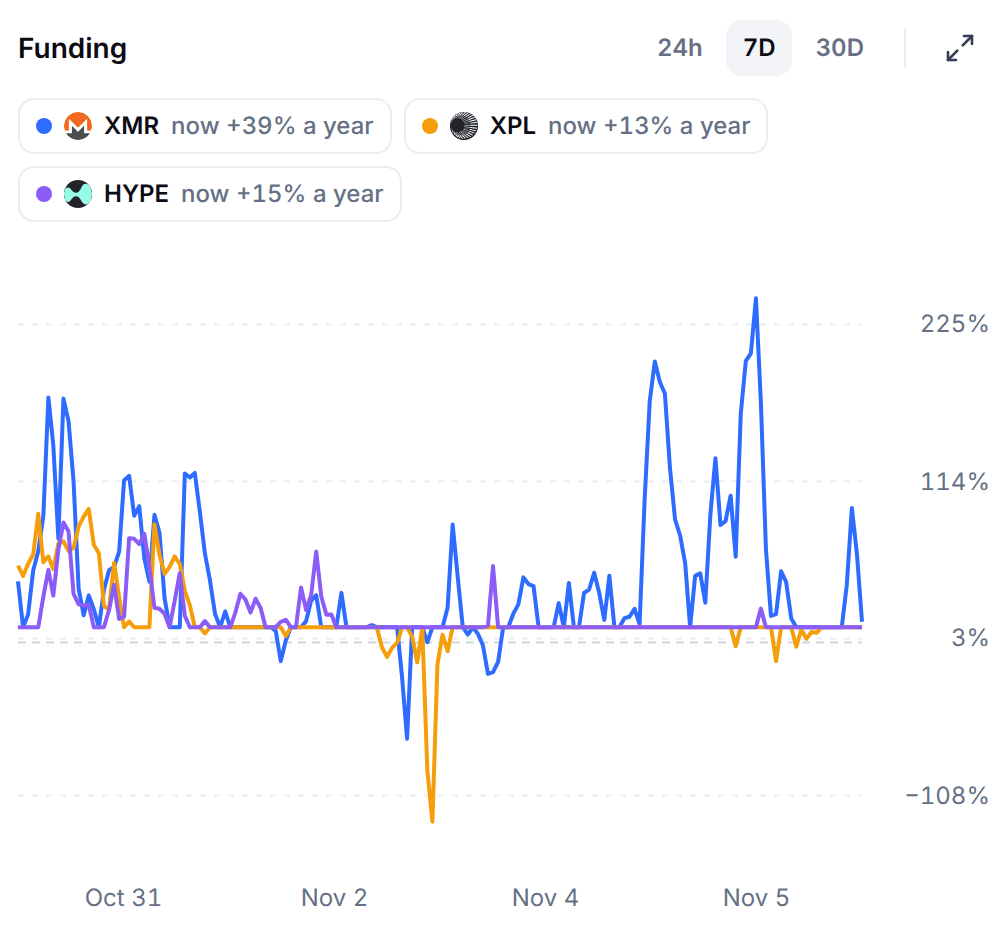
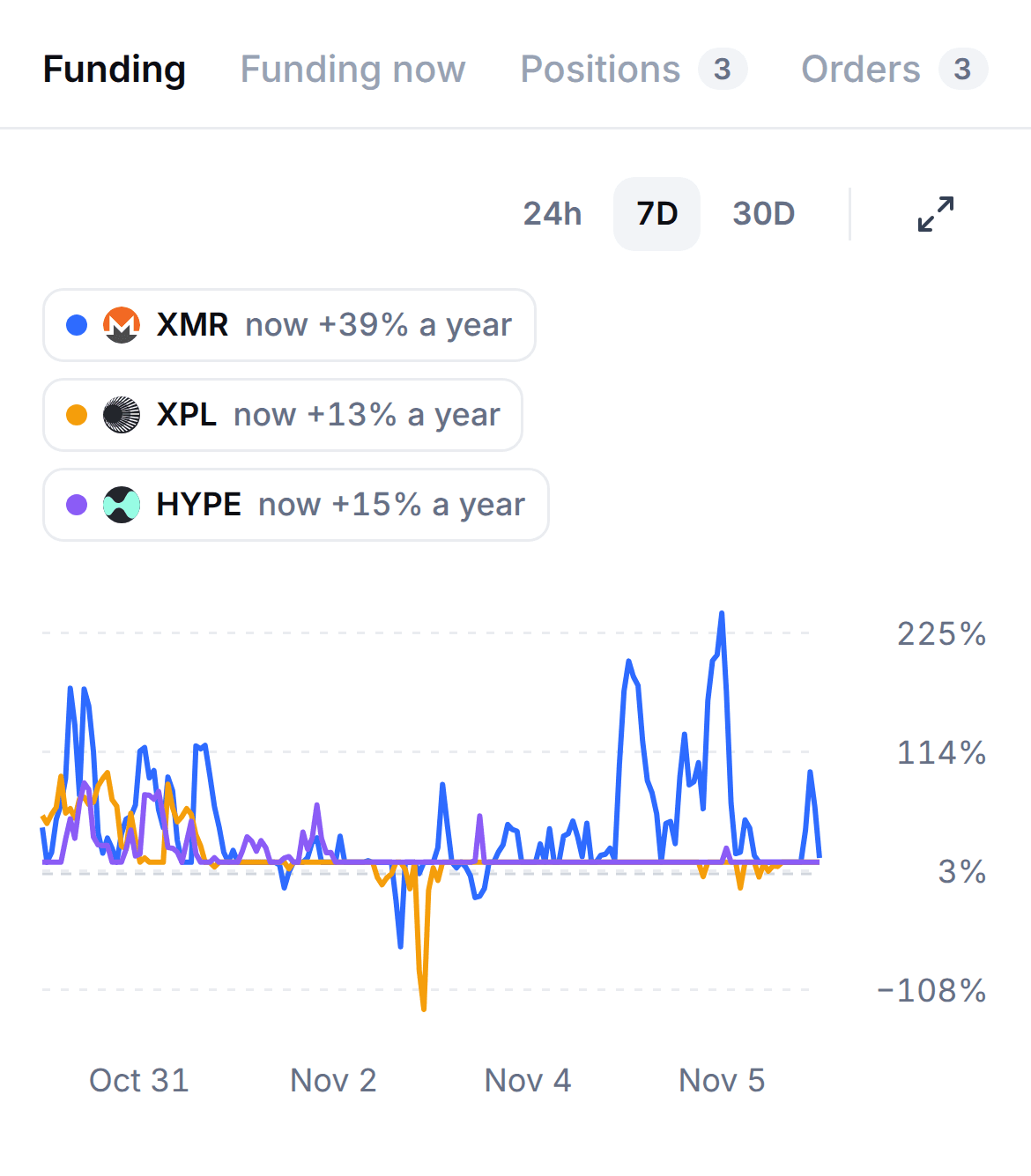
The Funding chart of a running Funding bot: a line for each coin it holds showing that coin's funding a year over 7 days, with the 24h, 7D and 30D buttons and each coin's rate now above the chart.
The funding of the coins a running bot holds, over 7 days, on Nov 6, 2026. The bot and its figures are a sample account's.
On a phone, a running Funding bot's page: the tabs Funding, Funding now, Positions and Orders, the 24h, 7D and 30D buttons, each coin's rate now and the funding chart of the coins it holds.
On a phone, a running Funding bot's chart on Nov 6, 2026: the funding of the coins it holds. The figures are a sample account's.
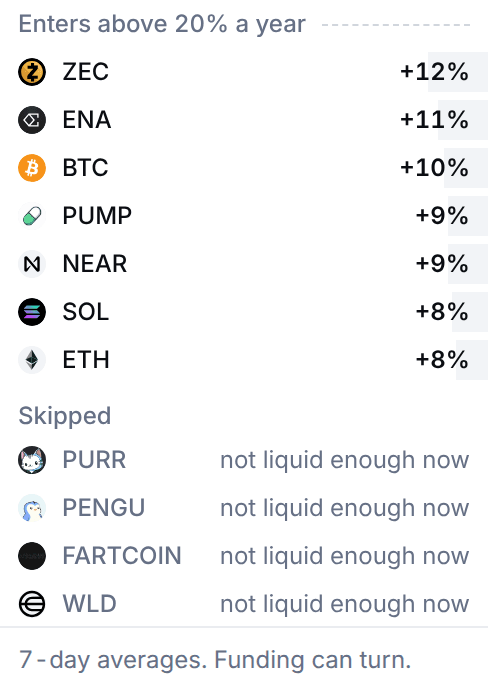
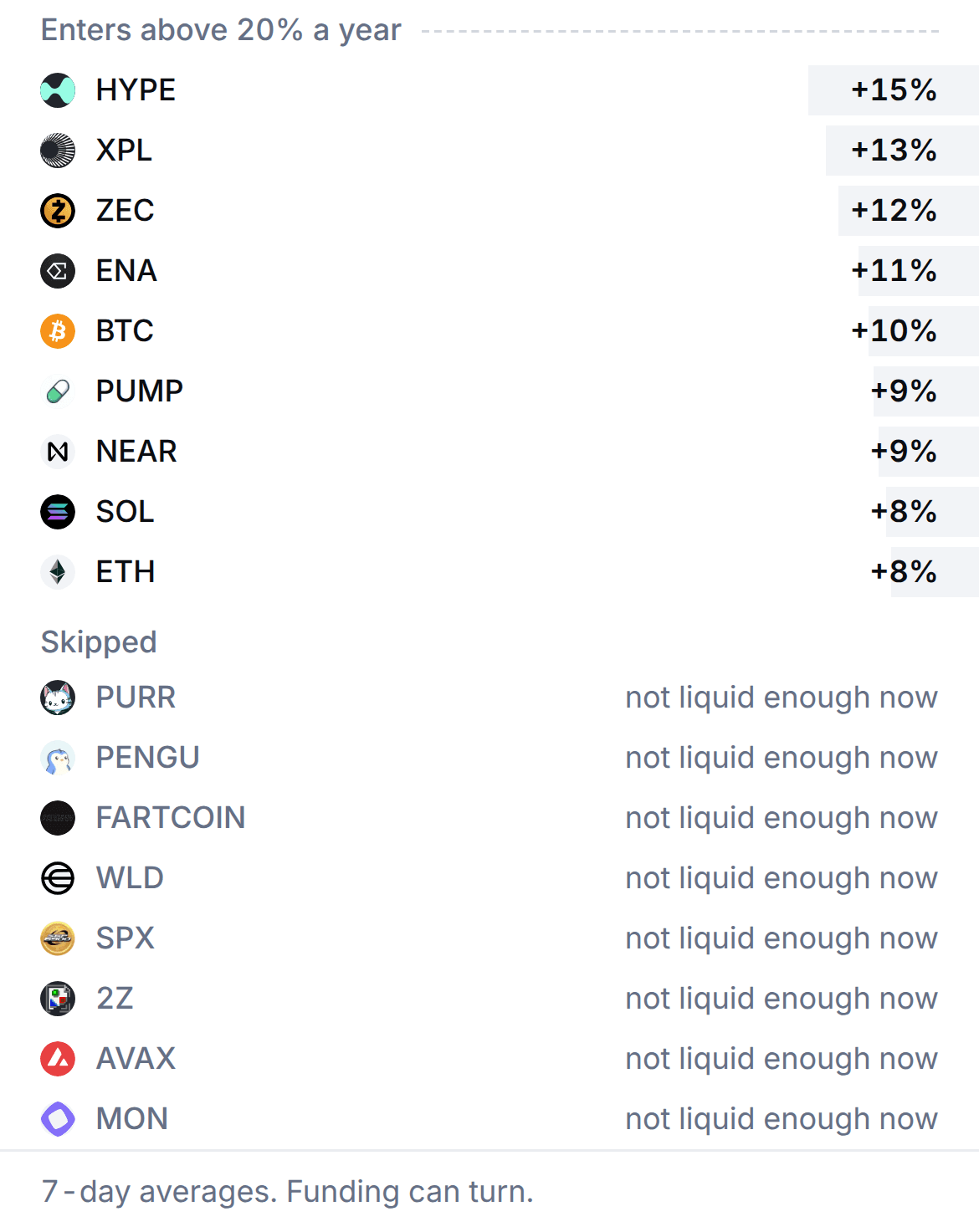
On a phone, Funding now under the line the bot enters above: the coins under it with their funding a year, the coins the bot skips and why, and a note that the figures are 7-day averages.
On a phone, Funding now on Nov 6, 2026, under the line the bot enters above. The figures are a sample account's.

Fast reaction or Steady?

Both modes run the same trade with the same margin rules. They differ in how fast they react. Fast reaction reads the last day of funding and decides every hour, so it follows funding moves within a day and trades more often, which costs more fees. Steady reads the last week and decides once a day, so it trades less and leaves a coin later when funding turns.

Fast reaction puts up to 3x on the short and Steady up to 2x, on cross margin backed by your USDC. A coin with a low maximum leverage trades lower: PURR at 2x, and 1x when the maximum is under 2.5x.

The two modes of the Funding bot, Fast reaction and Steady, side by side
What it doesFast reactionSteady
DecidesEvery hourOnce a day
Looks back24 hours7 days
Enters above25% a year20% a year
Minimum hold24 hours3 days
LeverageUp to 3xUp to 2x
Both decide just after Hyperliquid pays funding, Fast reaction at five past each hour and Steady at 00:05 UTC, and both leave a coin once its expected funding is below 0 and the minimum hold has passed.

What do the numbers look like?

Both examples hold one position: $10,000 of a coin on spot and a short of $10,000. Opening and closing it is four trades, and funding has to pay for them before it earns anything. The price does not change the result: it moves the coin and the short by the same amount.

  • $30.50

    To open and close

    Buying the coin costs $7.00, opening the short $7.00, selling the coin $9.50 and buying the short back $7.00. Each is Hyperliquid's taker fee (0.07% on spot, 0.045% on the perp) and, except for buying the coin, Prow's 0.025%. Slippage comes on top, and it is larger on the thin coins most funding comes from. Your own fee tier may be lower.

  • $6.85

    A day of funding at 25% a year

    That is Fast reaction's entry level; Steady's is 20%. A year of it is 25% of the short's value, and the position ties up more money than that: $13,333 at 3x, so the funding comes to about 19% a year on the money it uses.

  • about 4 days

    To earn the fees back

    At that rate $30.50 of fees takes that long to earn back. The bot enters only when 14 days of expected funding pay for the fees, and it holds a position at least 24 hours (Fast reaction) or 3 days (Steady).

Funding stays at the entry level

Fast reaction's entry level, 25% a year: the funding it has to expect before it opens a position.

Size
$10,000 of a coin on spot and a short of $10,000
Funding, paid to the short
0.00285% an hour, 25% a year
It collects
$6.85 a day
Money it ties up
$13,333: the coin in full and $3,333 of margin for the short at 3x
Fees to open and close
$30.50: $23.00 to Hyperliquid at base rates and $7.50 to Prow
Fees paid back in
about 4 days
What the price does
Moves the coin and the short by the same amount, so the result is the same
Funding stays at the entry level: the funding and what is left after all the fees, by how long it lasts
If it lastsFundingAfter fees
1 day+$6.85−$23.65
7 days+$47.95+$17.45
14 days+$95.90+$65.40
30 days+$205.50+$175.00

Slow, and positive. After 14 days the short has collected $95.90 and the fees took $30.50, which leaves $65.40. The price moved the coin either way, and the short moved the other way by the same amount.
Funding turns negative

The rate falls below zero and the short pays longs instead: the same rate, with the sign flipped.

Size
$10,000 of a coin on spot and a short of $10,000
Funding, paid by the short
0.00285% an hour, 25% a year
It pays
$6.85 a day
Money it ties up
$13,333: the coin in full and $3,333 of margin for the short at 3x
Fees to open and close
$30.50: $23.00 to Hyperliquid at base rates and $7.50 to Prow
Fees paid back in
Not while funding stays negative
What the price does
Moves the coin and the short by the same amount, so the result is the same
Funding turns negative: the funding and what is left after all the fees, by how long it lasts
If it stays negative forFundingAfter fees
1 day−$6.85−$37.35
2 days−$13.70−$44.20
3 days−$20.55−$51.05
7 days−$47.95−$78.45

The position keeps hedging the price, and costs $6.85 a day while this lasts. Fast reaction leaves after about a day and Steady can take several, and either way the fees to close come on top.

The yearly figure is on the short's value. The coin is paid in full and the short needs margin, so the money the position ties up is larger, $13,333 here at 3x. Funding changes every hour, and the bot holds a coin only while it expects it to pay.

How do I start a Funding bot in Prow?

You need a Hyperliquid account linked in Prow, on unified balance, with at least 300 USDC free. The bot buys the spot with that USDC and uses it as margin for the shorts, and it cannot move funds, so deposit first. A coin you already hold on spot is skipped.

  1. 01

    Open Bots, press Start a bot and pick Funding

    Funding is in the list of bot types. Tap a mode, or press Set up myself.

  2. 02

    Pick the account

    The bot needs One balance for spot and perps. If the account is not on it, press Switch to unified balance: your wallet signs it and it changes the whole account.

  3. 03

    Pick a mode and the amount

    Mode is Fast reaction or Steady. Capital is the USDC the bot may use, from 300 to 300,000, and 25%, 50% and Max fill in a share of what is free on the account. Under it the builder shows the positions the bot would open and the leverage.

  4. 04

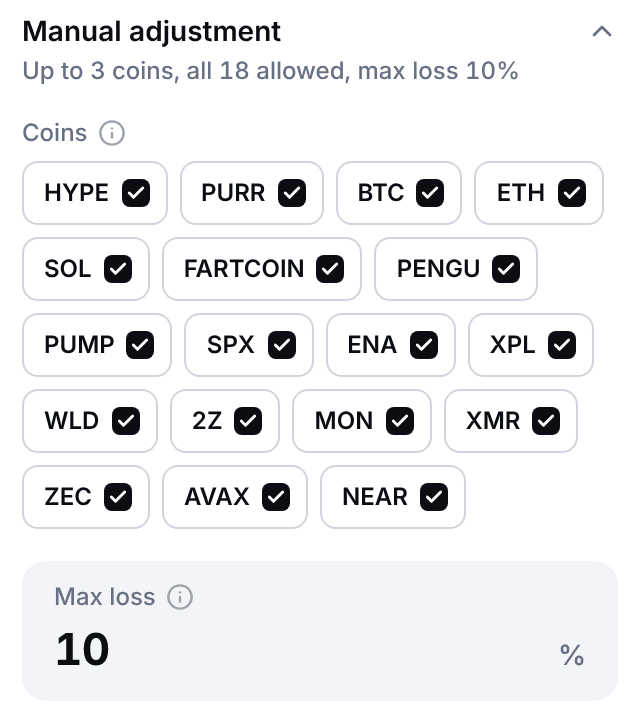
    Change anything under Manual adjustment

    Coins are the ones the bot may hold: all 18 by default, and at least 3. A coin you already hold on the account's spot is skipped. Max loss is a share of the capital, 10% by default: when the loss reaches it, every position closes and the bot stops.

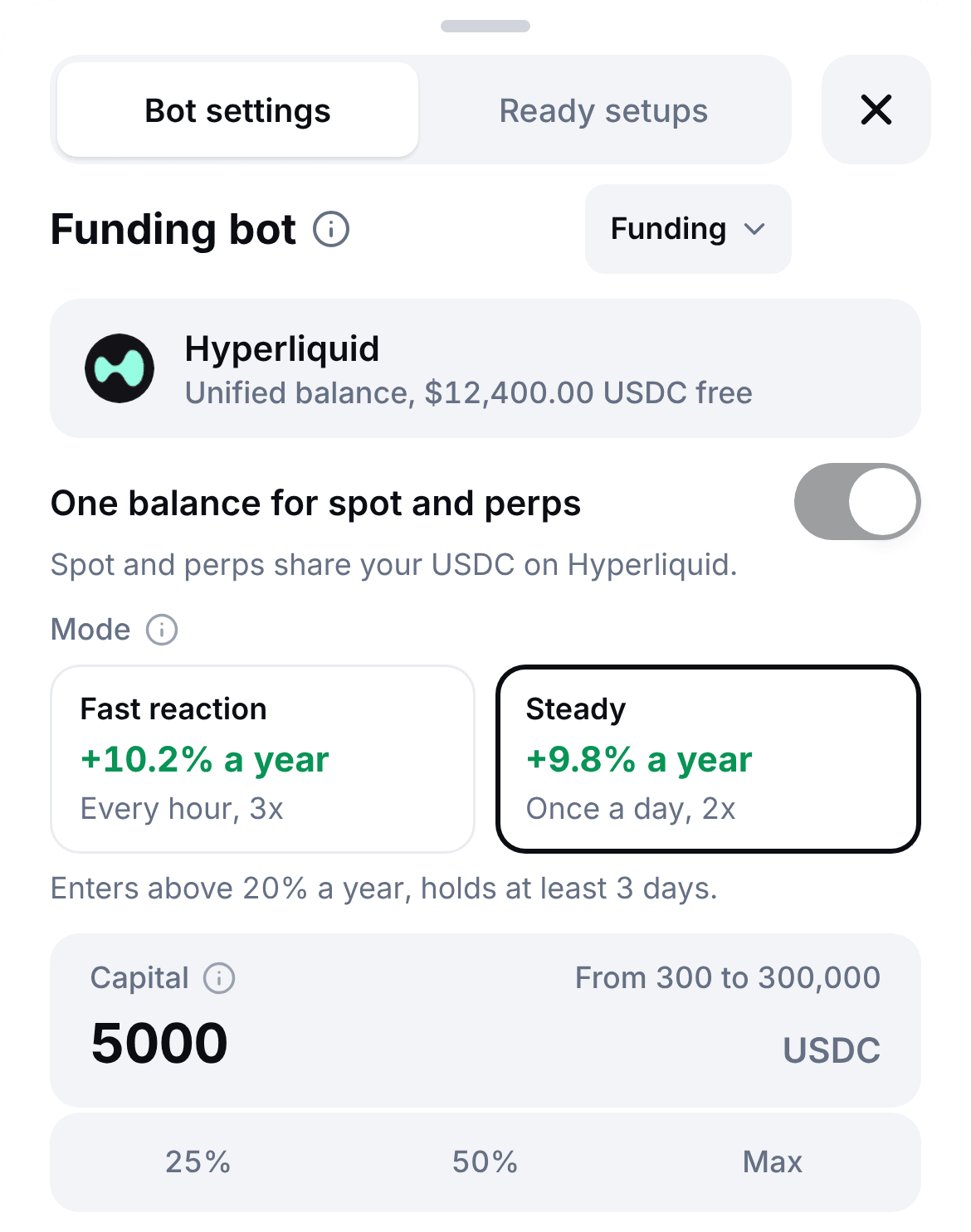
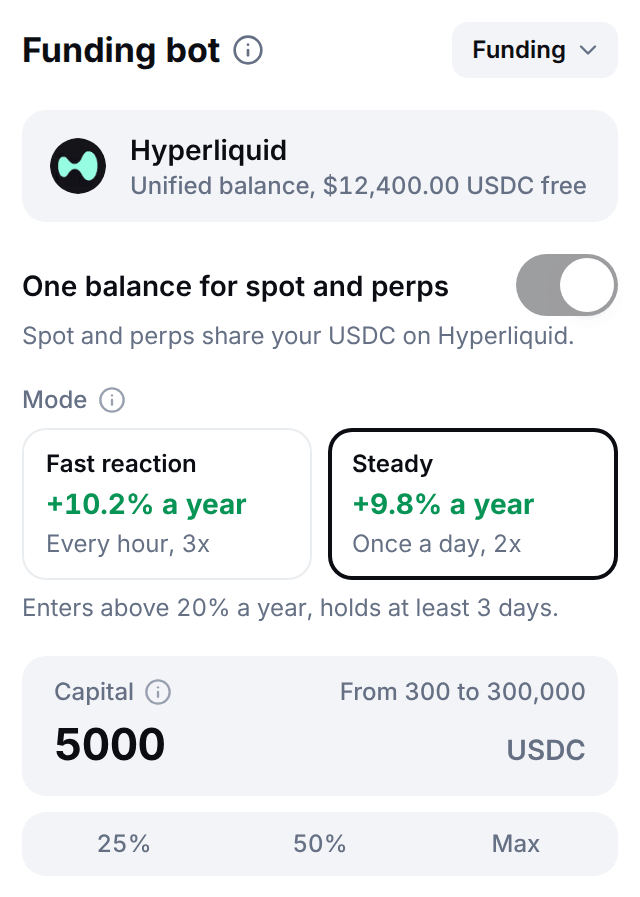
  5. On a phone, the Funding bot builder as a sheet: the account on unified balance, the Mode cards and the Capital field with its share chips.
    On a phone, the Funding bot builder on Nov 6, 2026: the account, the mode and the capital. The figures are a sample account's.
  6. 05

    Press Continue, read it and sign

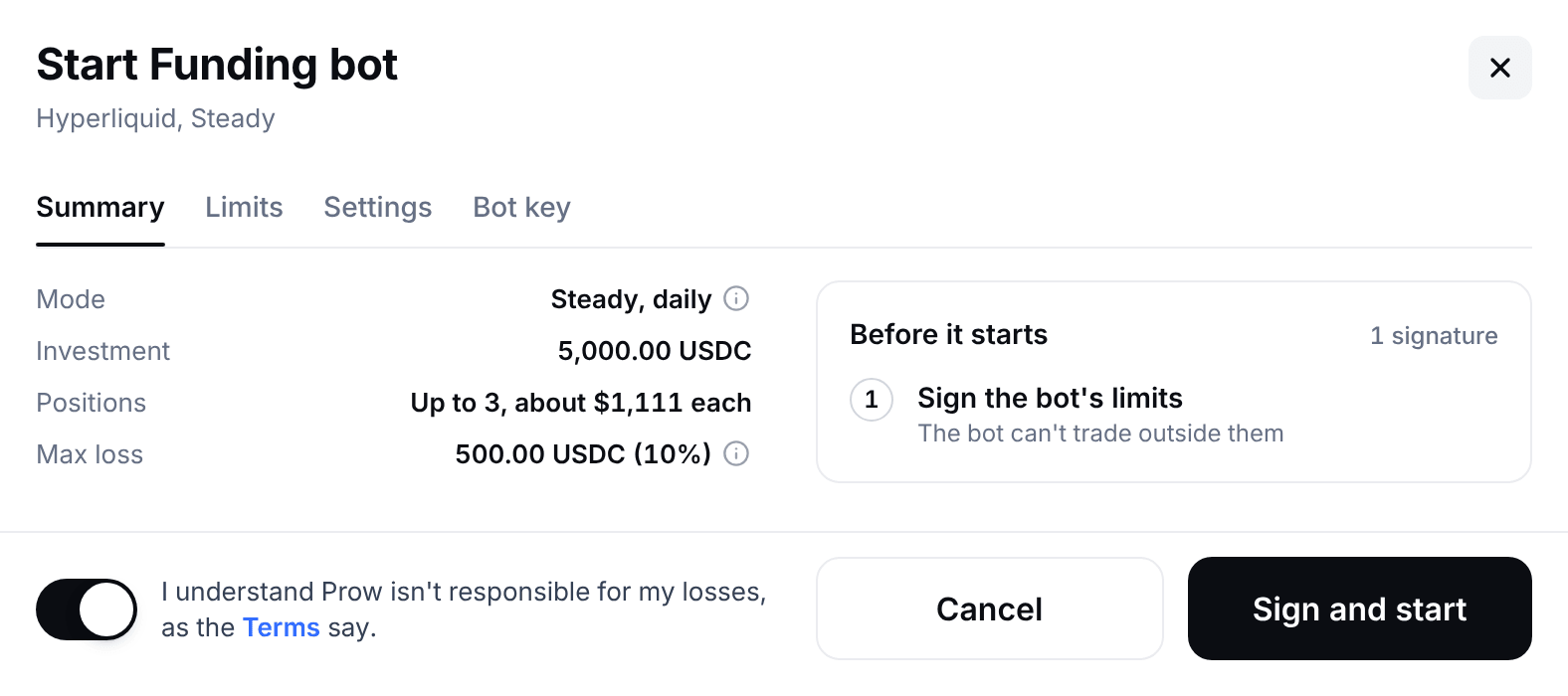
    Start Funding bot lists the mode, the investment and the max loss; Limits, Settings and Bot key list what you sign. Tick the risk acknowledgement and press Sign and start, which asks for up to three signatures. Then Open bot shows the bot's page.

Prow's Funding bot builder: the Hyperliquid account on unified balance with its free USDC, One balance for spot and perps switched on, the Mode cards for Fast reaction and Steady, and the Capital field with its 25%, 50% and Max chips.
Manual adjustment, open, in the Funding bot builder: the 18 coins the bot may hold, each ticked, and the Max loss field set to 10%.
The builder and its Manual adjustment on Nov 6, 2026: the account, the mode and the capital, then the coins and the max loss. The figures are a sample account's.
The Start Funding bot window: the mode, the investment, the positions and the max loss, the signature it needs before it starts, the risk acknowledgement, and the Cancel and Sign and start buttons.
The window a start opens on Nov 6, 2026: what starts, the signature it needs, the acknowledgement and Sign and start. The figures are a sample account's.

What does a running Funding bot show, and how do I stop it?

The bot's page looks like Trade: the funding of the coins it holds as a chart, the list of coins it picks from, and the bot's panel with its figures. Open bot shows it when the bot starts, and My bots lists it after that. Its first decision comes right after the next funding settlement, and some days nothing qualifies: the USDC waits.

  • The figures

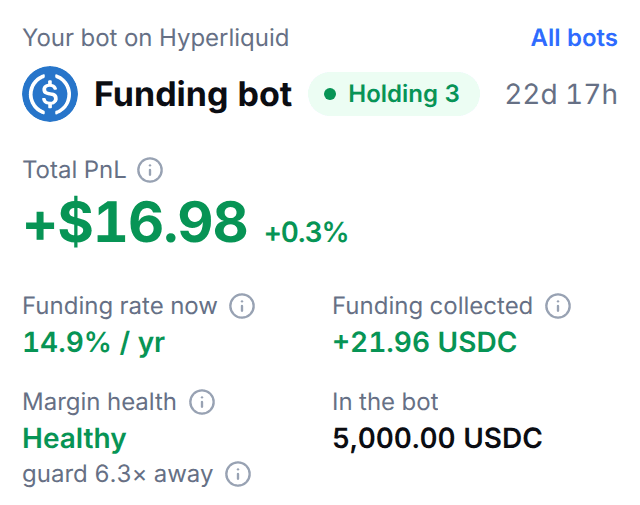
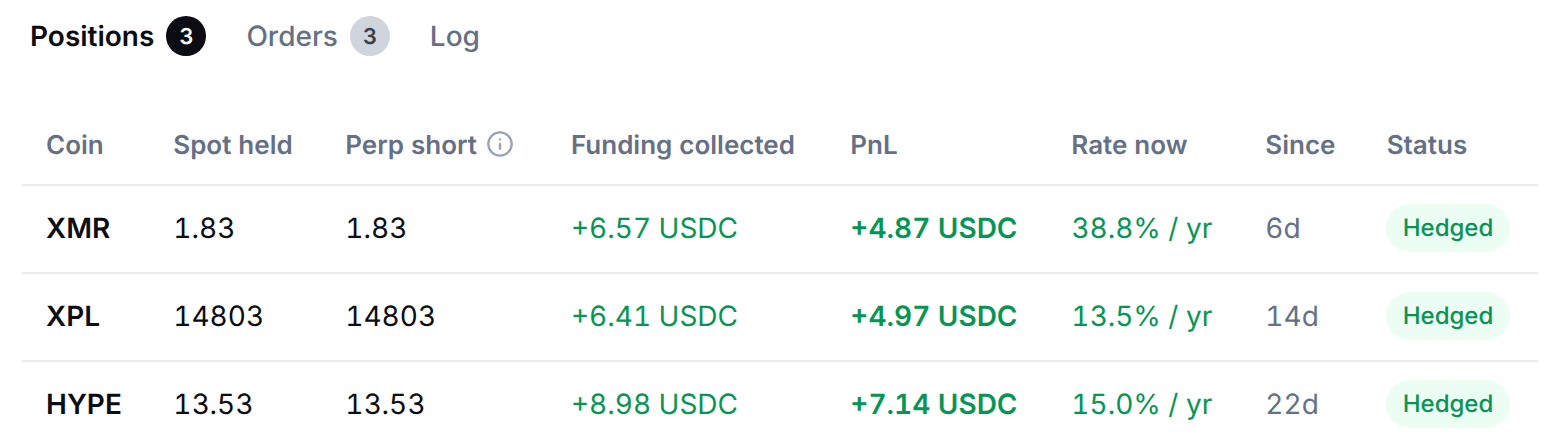
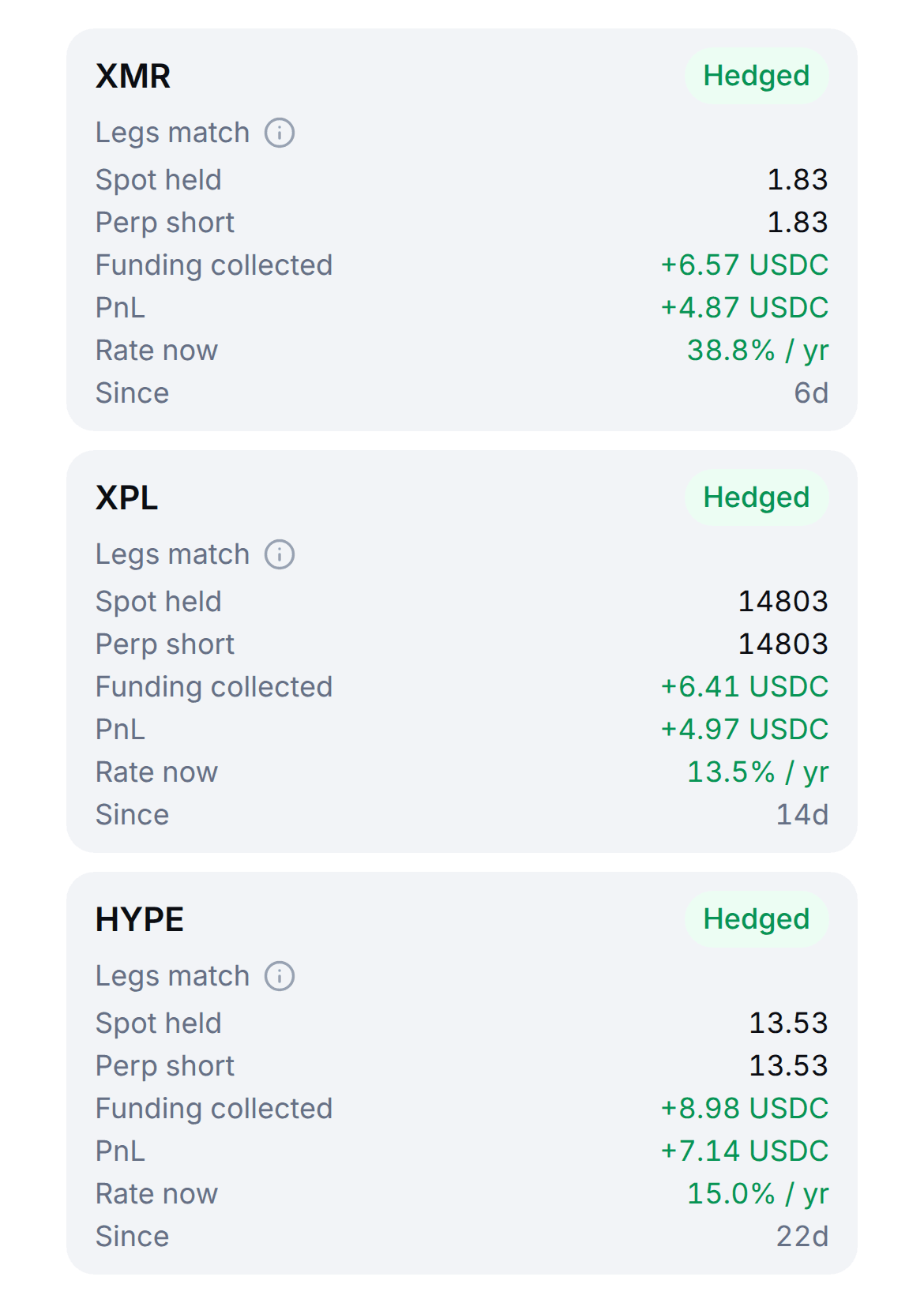
    The panel shows Total PnL, Funding rate now (what the open positions earn a year at today's rate, before fees), Funding collected, Margin health and In the bot. The Positions tab lists each position with its spot and its short side by side, which should match, its funding, profit and loss, rate now and age.

  • The notices

    A notice when the bot opens or closes a position and when it makes positions smaller. An urgent one when it closes them for margin, when a coin's spot drifts away from its perp or when the account leaves unified balance.

  • Pause and Stop

    Pause opens nothing new: open positions stay managed and close when their funding turns, and the margin guard keeps watching. There is no Edit, because the settings are part of the limits you signed: to change one, stop the bot and start a new one. Stop asks what happens to the positions: Close all positions at market, or Keep positions with their stops, which Prow then stops managing.

  • When the limits end

    The limits last 30 days at most, and the Prow Bots key 30 days. 2 hours before either ends, the bot closes its positions. The key renews with one signature. The limits cannot be renewed in place: to keep going, stop the bot and start a new one.

Funding now, under the line the bot enters above: the coins whose expected funding is under it, each with its funding a year, then the coins the bot skips with the reason, and a note that the figures are 7-day averages.
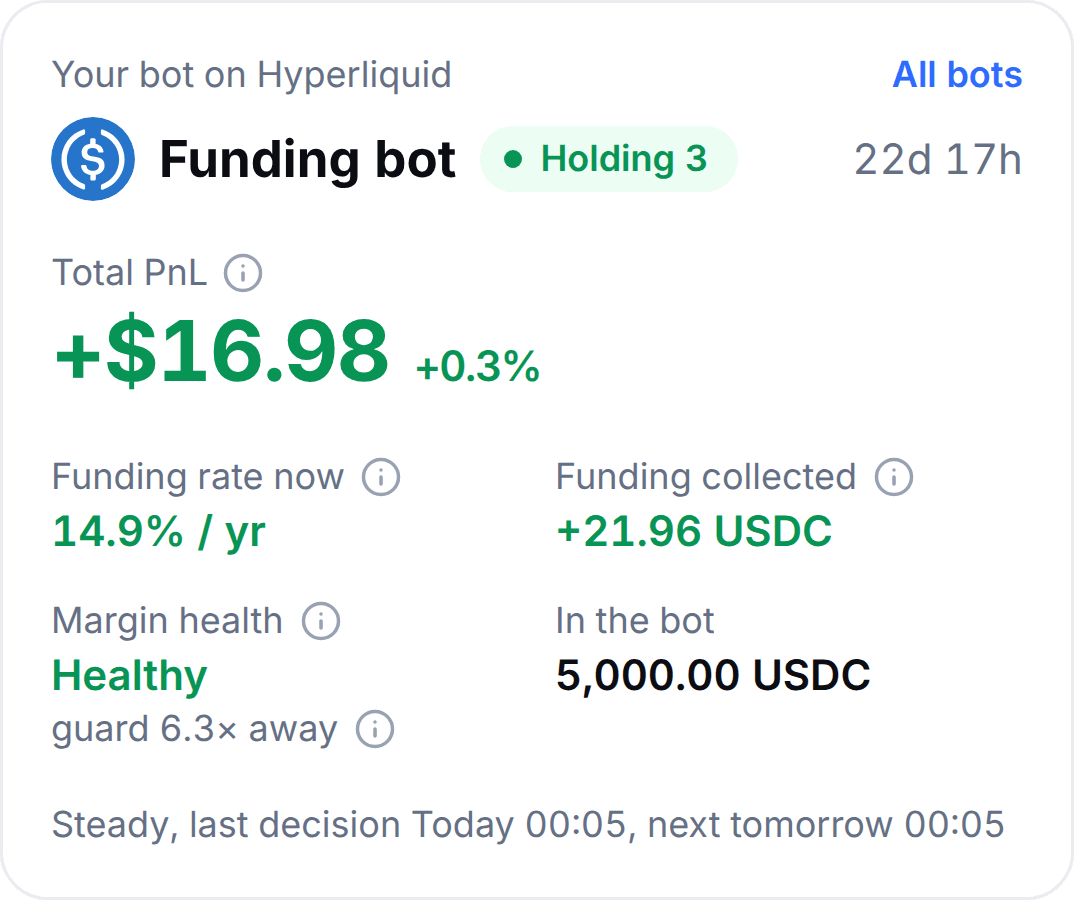
The panel of a running Funding bot: its name, its status Holding 3 and how long it has run, its total profit and loss, the funding rate now, the funding collected, the margin health and the USDC in the bot.
Funding now and the panel of a running bot on Nov 6, 2026: the coins under the entry line, its profit and its margin health. The figures are a sample account's.
The Positions tab of a running Funding bot: each coin with the spot held and the perp short side by side, the funding collected, the profit and loss, the rate now, its age and its status Hedged.
The Positions tab on Nov 6, 2026: both sides of every position, side by side. The figures are a sample account's.
On a phone, the card of a running Funding bot: its status, its total profit and loss, the funding rate now, the funding collected, the margin health, the USDC in the bot and the time of its last and next decision.
On a phone, a running Funding bot on Nov 6, 2026: its funding, its margin health and its profit and loss. The figures are a sample account's.
On a phone, the Positions tab of a running Funding bot: a card for each position with its status, the spot held, the perp short, the funding collected, the profit and loss, the rate now and its age.
On a phone, the Positions tab on Nov 6, 2026: one card for each position. The figures are a sample account's.

What do I control, and what can Prow not do with my keys?

Your money stays in your own Hyperliquid account. The venue, not Prow, stops the key from withdrawing: it has no withdrawal permission. Prow's servers check every order against the limits you sign, and if they go down, each short keeps its stop on Hyperliquid. More in the Prow Bots key.

You set

  • The mode, Fast reaction or Steady
  • The capital, from 300 to 300,000 USDC
  • The coins it may hold, at least 3 of the 18 (HYPE, PURR, BTC, ETH, SOL, FARTCOIN, PENGU, PUMP, SPX, ENA, XPL, WLD, 2Z, MON, XMR, ZEC, AVAX, NEAR)
  • The max loss, from 1% to 50% of the capital, 10% by default
  • Pause or stop, at any time

You sign

  • One Prow Bots key for the Hyperliquid account, with the first bot. It lasts 30 days and you renew it with one signature.
  • The Prow fee on Hyperliquid, once for the account.
  • The bot's limits, 30 days at most: this account, its coins, capital, positions, leverage and max loss. Prow's servers refuse every order outside them.

What the key can't do

  • Withdraw your funds
  • Send funds to another address or account
  • Approve another key
  • Change your account's settings: switching to unified balance is signed by your own wallet

The bot sells only what it bought, so the coins you already hold on spot are never sold.

When does the Funding bot not pay?

  • Funding turns negative

    The shorts pay instead of collecting. The bot leaves once its expected funding is below 0 and the minimum hold has passed: within about a day for Fast reaction, possibly several days for Steady. The shorts pay meanwhile, and every switch between coins pays fees on both sides.

  • Fees on every trade

    Opening and closing a position is four trades and costs about 0.305% of its size before slippage, $30.50 on $10,000. At 25% a year that is about 4 days of funding, and thin coins cost more in slippage.

  • A few coins carry the funding

    Funding on BTC and ETH rarely clears the entry level. Most of it comes from a few smaller coins such as PURR, HYPE, FARTCOIN and XMR, and when those cool off nothing qualifies. A coin you already hold on spot is skipped, so holding one of them leaves the bot fewer coins to pick from.

  • A fast rise strains the shorts

    The shorts lose USDC while the spot gains in coins. After about a 10 to 15% rise of the coins it holds the bot starts cutting positions, and it closes them all if the rise continues, which costs fees. If Prow's servers are down, Hyperliquid can liquidate a short after about a 20 to 30% rise, less on coins with a low maximum leverage, and each short's stop on Hyperliquid fires a little before.

  • The shorts share your margin

    They are backed by the account's whole USDC balance, which Hyperliquid calls cross margin. Your other positions, other bots and withdrawals on the same account share that margin, and a loss or a buy there brings the shorts' liquidation closer. A dedicated account is safer, and switching to unified balance changes the whole account.

  • A bridge can break

    Most of the spot coins, such as UBTC, UETH and USOL, are bridged tokens. If a bridge breaks, a token can lose its peg: the spot falls while the short does not gain. The bot closes a position whose spot stays 5% or more away from its perp for 10 minutes.

  • Some of your USDC sits idle

    The bot holds up to 3 positions and enters a coin only above its entry level, so part of the capital is often in USDC, which earns nothing. Larger amounts earn less: a position is capped at 5% of its coin's daily volume, and every Prow Funding bot shares that cap.

  • It removes the price risk of the coins it holds and adds the risks above.

Questions about the Funding bot

How does a funding rate bot work?

A funding rate bot holds two opposite positions in the same coin: the coin itself, bought on the spot market, and a short of the same size on its perp. When the price moves, the two cancel out. What the short collects is funding, a small payment that longs pay shorts on a perp when more traders are long, which Hyperliquid settles every hour. Prow's Funding bot does this on your own Hyperliquid account: it follows the funding of 18 coins that have a spot market, holds up to 3 at a time and moves to the coins whose funding is expected to pay most. It is not risk-free: funding can turn negative, and the shorts need margin.

Read more: How a funding rate bot works: rotation, modes, results, Cash and carry trade in crypto: Hyperliquid spot and perp

How much can a funding rate bot earn?

It depends on funding, which changes every hour, so there is no fixed rate. For scale, a short collects $6.85 a day on a $10,000 position when funding is 25% a year, Fast reaction's entry level, and opening and closing the position costs $30.50 before slippage, which takes about 4 days of that funding to earn back. Funding on BTC and ETH rarely clears the entry level, and funding turns negative at times, so part of your USDC is often idle, and idle USDC earns nothing. The live funding of every coin is on the funding rates page.

Read more: Funding rates now, by venue

How does the bot choose its coins?

It predicts the funding of each of the 18 coins that have a spot market (HYPE, PURR, BTC, ETH, SOL, FARTCOIN, PENGU, PUMP, SPX, ENA, XPL, WLD, 2Z, MON, XMR, ZEC, AVAX, NEAR) from what Hyperliquid has already paid: the last day for Fast reaction, the last week for Steady, recent hours counting more. Fast reaction decides every hour and Steady once a day at 00:05 UTC. A coin is entered when its expected funding is above 25% a year (Fast reaction) or 20% (Steady) and 14 days of it would pay for the fees, held at least 24 hours or 3 days and left once the expected funding is below 0. With 3 coins held, the weakest is swapped for a better one only when 14 days of the extra funding beat 3 times the cost of swapping.

Read more: Funding bot in the docs

What happens when funding turns negative?

The short pays funding instead of collecting it. The bot leaves a coin once its expected funding is below 0 and the minimum hold has passed: within about a day for Fast reaction, possibly several days for Steady, which decides once a day on a 7-day average. The short pays meanwhile: at −25% a year that is $6.85 a day on a $10,000 position, and closing costs fees on top. Every switch between coins pays fees on both sides.

Read more: Hyperliquid funding rates: how hourly funding works

Can the shorts be liquidated?

Yes, if a coin's price rises far enough, though the bot acts well before. The shorts are backed by your account's whole USDC balance (cross margin), so a rise costs them USDC while the spot gains in coins. After about a 10 to 15% rise the bot makes every position smaller, and at 1.5 times the shorts' maintenance margin, the minimum Hyperliquid asks for, it closes them all. Each short also rests a stop on Hyperliquid, for when Prow's servers are down: Hyperliquid can liquidate a short after about a 20 to 30% rise, and the stop fires a little before that. The margin is shared with your other positions and bots, so a dedicated account is safer.

Read more: Liquidation price on Hyperliquid and Aster, with examples, Is delta neutral risk-free? How hedged trades lose money

How much money do I need, and what is a unified account?

At least 300 USDC and at most 300,000 per bot, free on a Hyperliquid account on unified balance. Unified balance means spot and perps share one USDC balance, so the spot you buy and the shorts' margin come out of the same money. If your account is not on it, the builder offers Switch to unified balance: your wallet signs it, nothing moves, and it changes the whole account, your own trades and other bots included. Portfolio margin is not supported. Coins you already hold on the account's spot are skipped: the bot only sells what it bought. Larger amounts earn less, because a position is capped at 5% of its coin's daily volume.

Read more: Funding bot in the docs

Can the bot withdraw my money?

No. It trades with a key called Prow Bots. The key can place and cancel the bot's orders and set leverage, but it cannot withdraw, send funds to another address or account, approve another key or change your account's settings: switching to unified balance is signed by your own wallet. Prow's servers check every order against limits you sign, and the key expires after 30 days unless you renew it with one signature.

Read more: The Prow Bots key, Hyperliquid agent wallets: why a trading key can't withdraw

What does the Funding bot cost?

Hyperliquid's taker fees (0.045% on perps and 0.07% on spot at the base tier) and Prow's fee, 0.025%, on the bot's perp orders and its spot sales. A spot purchase carries no Prow fee. Opening and closing one $10,000 position is four trades and costs $30.50 before slippage, $23.00 to Hyperliquid and $7.50 to Prow. There is no subscription. Funding is not a fee: the short collects it or pays it. Prow's 0% launch fee, until Dec 31, 2026, is for orders you place yourself in the app: a bot pays the fee from its first fill.

Read more: Fees, Perp DEX fees compared

How is it different from the funding bots on Binance, Bitget and Pionex?

Exchange bots such as Binance's Funding Rate Arbitrage Bot and Bitget's hold your money on the exchange and trade the one coin you pick, for example BTC against USDT, and both can also run the trade backwards when funding is negative. Pionex's Arbitrage products pair spot with a perp short on a short list of large coins such as BTC, ETH and SOL. Prow's Funding bot runs on your own Hyperliquid account with a key that can't withdraw, picks among 18 coins itself and runs one direction only: a coin on spot and a short on its perp, leaving when funding turns. Checked on Nov 6, 2026.

Read more: Binance's Funding Rate Arbitrage Bot, Bitget's Funding Rate Arbitrage Bot, Pionex's Arbitrage products

Can I use it today?

Bots are switched on account by account. Any Prow account can open the builder, but starting a Funding bot needs bots switched on for your account. If they are not, Continue stays off and nothing is signed or placed. You also need a Hyperliquid account linked in Prow, on unified balance, with at least 300 USDC free.

Read more: Funding bot in the docs