Skip to content

Arbitrage bot for Hyperliquid and Aster

Prow's bot holds a long and a short in one coin on two markets and earns the funding gap. It opens a pair only when the gap pays all its costs, so most of the time it waits.

  • Hyperliquid
  • Aster
  • Funds stay in your accounts
  • The key can't withdraw

Bots are switched on account by account. Any Prow account can open the builder.

Trades
Funding gaps
Your money
In your accounts
Leverage
1x to 3x, isolated
The key
Can't withdraw
Runs up to
30 days
Prow's fee on perps
0.01% to 0.025%

What is the arbitrage bot for?

It is not a yield product. Funding gaps between venues are usually small and short-lived, so the useful part of this bot is that it trades only the gaps that are worth it and keeps the two legs matched while it does. It runs on Prow's servers around the clock, so nothing has to stay open on your device.

Idle money on two venues

If you keep margin on both Hyperliquid and Aster, the bot holds a long on one venue and a short on the other when their funding differs enough to pay.

A position you can read

Every pair is two legs of the same size. The bot's page lists each pair with its size, the spread at entry, funding, profit and loss and age, and opens it up to show both legs.

A bot that says no

It enters only when the expected funding covers every cost, and it closes when that stops being true. Most of the time nothing qualifies, and the bot waits.

How does arbitrage between perp DEXs work?

A perp, short for perpetual future, is a contract on a coin's price with no end date. To keep it close to the coin's real price, longs and shorts pay each other a small amount on a schedule. That payment is called funding. When the rate is positive, longs pay shorts. Hyperliquid settles funding every hour, and Aster every 1 to 8 hours depending on the market.

The same coin often has a different rate on each venue. Hold a long where funding is lower and a short of the same size where it is higher: you pay the low rate, receive the high one and keep the difference. Because the two sides are the same size, a price move that helps one hurts the other by about as much. That is why it is called market-neutral, or delta neutral.

Funding gaps last hours to days, not seconds, so the work is in the costs, the sizing and keeping both legs safe, not in speed.

The first example below, drawn out

HyperliquidLong

$10,000 of BTC

Pays funding
0.00125% an hour
If BTC rises 5%
+$500
AsterShort

$10,000 of BTC

Receives funding
0.00375% an hour
If BTC rises 5%
−$500

Same coin, same size: the price moves cancel out.

You pay 0.00125% and receive 0.00375% an hour, so you keep the gap:

0.0025% an hour

$0.25 an hour, $6.00 a day on $10,000

Opening and closing both legs is four trades: about $20.00 in fees, $13.00 to the venues at base rates and $7.00 to Prow. The gap has to last long enough to pay for them.

Which kinds of arbitrage can a bot trade on perp DEXs?

  • Funding spread

    What you hold
    A long on one perp DEX and a short of the same size on another
    What you earn
    The difference in funding

    Does Prow's bot trade it?

    Yes, between Hyperliquid and Aster

  • Spot against perp

    What you hold
    The coin on spot and a short of the same size on its perp, on one venue
    What you earn
    Positive funding, paid to the short

    Does Prow's bot trade it?

    Yes, on Hyperliquid

  • Price gap

    What you hold
    A long where the price is lower and a short where it is higher
    What you earn
    The two prices meeting again

    Does Prow's bot trade it?

    No. Most of the gap between Hyperliquid and Aster is a steady difference between USDC and USDT prices, so little is left to earn after fees

How does the bot open and close a pair?

Every few seconds it scores each coin on your list. Pause stops new pairs and leaves open ones managed by their rules; only your Stop, or an emergency close by Prow, closes pairs at market.

  1. 01

    It scores every coin on your list

    It works out what each coin's funding gap would earn over your horizon, 3 days by default, and takes off the fees on both venues, Prow's fee, slippage and an allowance for the two prices drifting apart.

  2. 02

    It waits for a gap that pays

    It enters only when the result is positive and at least your entry level, 8% a year after costs by default. A coin it has just closed waits 12 hours before it can open again.

  3. 03

    It builds the pair leg by leg

    One leg rests as a limit order, usually on Aster, priced from Hyperliquid's order book, and pays the lower maker fee. When it fills, the other leg goes in at market on the other venue, within your hedge slippage, 0.3% by default. A pair is built in small orders, and each fill is matched on its own.

  4. 04

    If the second leg fails, the first is sold back

    If the second leg can't be placed in time, by default within 5 seconds, the first is sold back. A small loss costs less than a lone position.

  5. 05

    It watches both legs

    Each leg carries a stop on its own venue and an order that closes it if the other leg's stop fires, so a stop on one venue closes both even while Prow is down. The bot's own guard closes the pair earlier, at 75% of the way to liquidation by default.

  6. 06

    It closes both legs together

    When the spread has closed, when funding has gone against the pair for two settlements in a row, after the max hold (7 days by default), when a leg nears liquidation, when the max loss is reached, 2 hours before its signed limits or its key end, or when you press Stop.

What do the numbers look like?

Both examples hold $10,000 on each side at 2x, so each venue locks $5,000 of margin. Opening and closing a pair is four trades, and the gap has to pay for all of them before it earns anything.

  • $13.00

    To the venues

    The four trades at base-tier fees: $0.00 + $4.50 + $4.50 + $4.00. The bot opens with an Aster limit order (0%) and a Hyperliquid market order (0.045%), and closes both legs at market (0.045% and 0.04%).

  • $7.00

    To Prow

    Prow's fee is 0.025% on a Hyperliquid perp fill ($2.50) and 0.01% on an Aster perp fill ($1.00), for the four. A spot against perp pair also pays it on its Hyperliquid spot sells, never on its spot buys. It is 0% on orders you place yourself until Dec 31, 2026; a bot pays it from its first fill.

  • $20.00

    In all

    What the gap has to pay back before a pair earns anything. Your own venue fee tier may be lower.

A gap that looks big and does not pay

Aster's funding is 3 times Hyperliquid's resting rate.

Size
$10,000 of BTC on each side
Long pays
0.00125% an hour on Hyperliquid
Short receives
0.00375% an hour on Aster
The gap
0.0025% an hour, 21.9% a year
It earns
$0.25 an hour, $6.00 a day
Fees to open and close
$20.00: $13.00 to the venues at base rates and $7.00 to Prow
Fees paid back in
about 80 hours
A gap that looks big and does not pay: what the pair earns and what is left after all the fees, by how long the gap lasts
If the gap lastsIt earnsAfter fees
6 hours$1.50−$18.50
1 day$6.00−$14.00
3 days$18.00−$2.00
7 days$42.00+$22.00

At the bot's default settings it would not open this pair. Three days of it earns $18.00 and the fees take $20.00, which leaves −$2.00. The entry level, 8% a year after costs, asks for at least $6.58 over those days, before slippage and the allowance for the two prices drifting apart.

A wide gap, if it lasts

A smaller coin whose funding spiked on Aster to 0.02% an hour, while Hyperliquid stayed at its resting rate.

Size
$10,000 of a smaller coin on each side
Long pays
0.00125% an hour on Hyperliquid
Short receives
0.02% an hour on Aster
The gap
0.01875% an hour, 164% a year
It earns
$45.00 a day
Fees to open and close
$20.00: $13.00 to the venues at base rates and $7.00 to Prow
Fees paid back in
about 11 hours
A wide gap, if it lasts: what the pair earns and what is left after all the fees, by how long the gap lasts
If the gap lastsIt earnsAfter fees
6 hours$11.25−$8.75
1 day$45.00+$25.00
3 days$135.00+$115.00
7 days$315.00+$295.00

This is the kind of gap the bot waits for. It still has to last: gaps like this can close within hours, and funding can turn against the pair. If it closes after 6 hours, the pair has earned $11.25 and paid $20.00 in fees, a result of −$8.75.

The yearly figures (21.9% and 164%) are what the gap would add up to if it never changed. It always changes, which is why the bot also asks what the gap earns over 3 days.

What the spreads look like right now

10 funding pairs between Hyperliquid and Aster are on the bot's list right now. None of them pays after costs. The widest funding gap is 12.1% a year, on DOGE. Opening and closing both legs of a pair costs 0.22% to 0.29% of one side's size, and the gap has to last long enough to pay that back. The 6 closest to paying are below.

Read from Prow's scanner, as of . It checks again every 10 seconds; this page keeps a copy for up to a minute.

Funding pairs between Hyperliquid and Aster, the pairs closest to paying first
CoinLong onShort onFunding gap, a yearCost to open and closeAfter costs, 3 days, per $1,000Fees paid back in
BNBAsterHyperliquid0.6%0.23%−$4.37not reached
BTCHyperliquidAster0.0%0.22%−$4.82not reached
ASTERHyperliquidAster2.4%0.29%−$5.55about 14.7 days
SOLHyperliquidAster7.3%0.23%−$5.76not reached
HYPEAsterHyperliquid0.0%0.22%−$5.94not reached
DOGEHyperliquidAster12.1%0.23%−$6.29not reached
  • BNB

    Long on Astershort on Hyperliquid

    Funding gap, a year
    0.6%
    Cost to open and close
    0.23%
    Fees paid back in
    not reached
    After costs, 3 days, per $1,000
    −$4.37
  • BTC

    Long on Hyperliquidshort on Aster

    Funding gap, a year
    0.0%
    Cost to open and close
    0.22%
    Fees paid back in
    not reached
    After costs, 3 days, per $1,000
    −$4.82
  • ASTER

    Long on Hyperliquidshort on Aster

    Funding gap, a year
    2.4%
    Cost to open and close
    0.29%
    Fees paid back in
    about 14.7 days
    After costs, 3 days, per $1,000
    −$5.55
  • SOL

    Long on Hyperliquidshort on Aster

    Funding gap, a year
    7.3%
    Cost to open and close
    0.23%
    Fees paid back in
    not reached
    After costs, 3 days, per $1,000
    −$5.76
  • HYPE

    Long on Astershort on Hyperliquid

    Funding gap, a year
    0.0%
    Cost to open and close
    0.22%
    Fees paid back in
    not reached
    After costs, 3 days, per $1,000
    −$5.94
  • DOGE

    Long on Hyperliquidshort on Aster

    Funding gap, a year
    12.1%
    Cost to open and close
    0.23%
    Fees paid back in
    not reached
    After costs, 3 days, per $1,000
    −$6.29

Costs are both venues' fees, Prow's fee on a bot's perp fills (0.025% on Hyperliquid and 0.01% on Aster) and slippage, for opening and closing both legs, plus an allowance for the two prices drifting apart. Every coin, and how each number is made, is in the app under Market signals, Arbitrage opportunities: see the spreads in the app. For funding on every perp, see live funding rates.

How do I start an arbitrage bot in Prow?

You need accounts on Hyperliquid and Aster linked in Prow, with USDC on Hyperliquid and USDT on Aster, and Aster set to one-way position mode with single-asset margin, as for every bot. A spot against perp pair needs only the Hyperliquid account, with USDC in its spot balance.

  1. 01

    Open Bots and press Start a bot

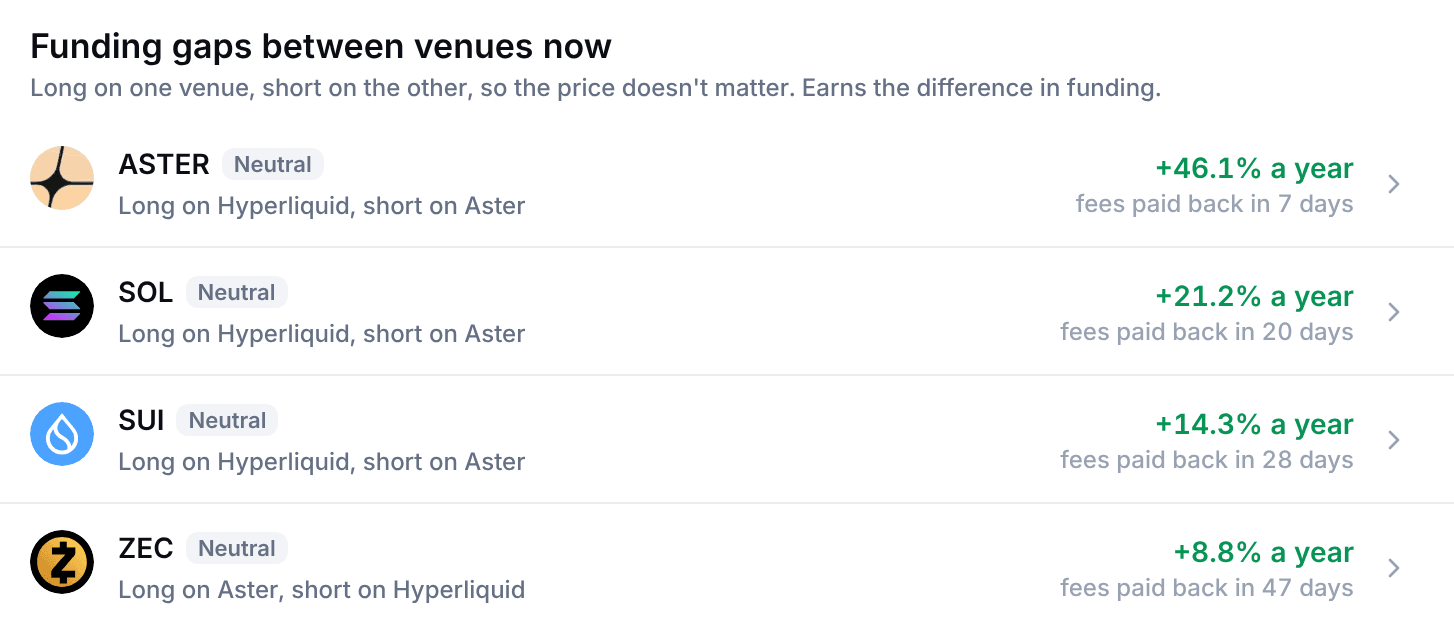
    Pick Arbitrage. Its pane lists the funding gaps between Hyperliquid and Aster now: tap one to open the builder on that coin, or press Set up myself. A row of Market signals, Arbitrage opportunities starts it too, with the coin filled in.

  2. 02

    Pick the investment and the leverage

    Investment is the most the bot may use across both venues. Leverage per leg is 1x to 3x, isolated, 2x by default. The box The pair now shows the funding gap, how long the fees take to pay back and the size of each leg.

Prow's Start a bot screen on Arbitrage: a list of coins whose funding differs between Hyperliquid and Aster, each with the venue it is long on and the venue it is short on, the gap as a rate for a year and how many days the fees take to pay back.
Start a bot, Arbitrage, on Nov 5, 2026: the funding gaps between Hyperliquid and Aster, each with how long the fees take to pay back. The rates change every hour.
  1. 03

    Change anything under Manual adjustment

    Coins (1 to 10), pairs at once (up to 3), size per pair, entry level, horizon, max hold and the safety limits. The defaults are the ones this page describes, and the docs explain every setting.

  2. 04

    Press Continue and read the review

    Review Arbitrage bot shows what a pair costs to open and close, how long today's spread takes to pay that back, the margin used on each venue and the nearest liquidation. Tick the acknowledgement and press Continue.

  3. 05

    Press Sign and start

    Each account without a Prow Bots key asks for one signature, and Approve the Prow fee on Hyperliquid is one more, once. Then Sign the bot's limits: one signature if the same wallet owns both accounts. Prow's servers refuse any order outside those limits.

  4. 06

    Watch it on the bot's page

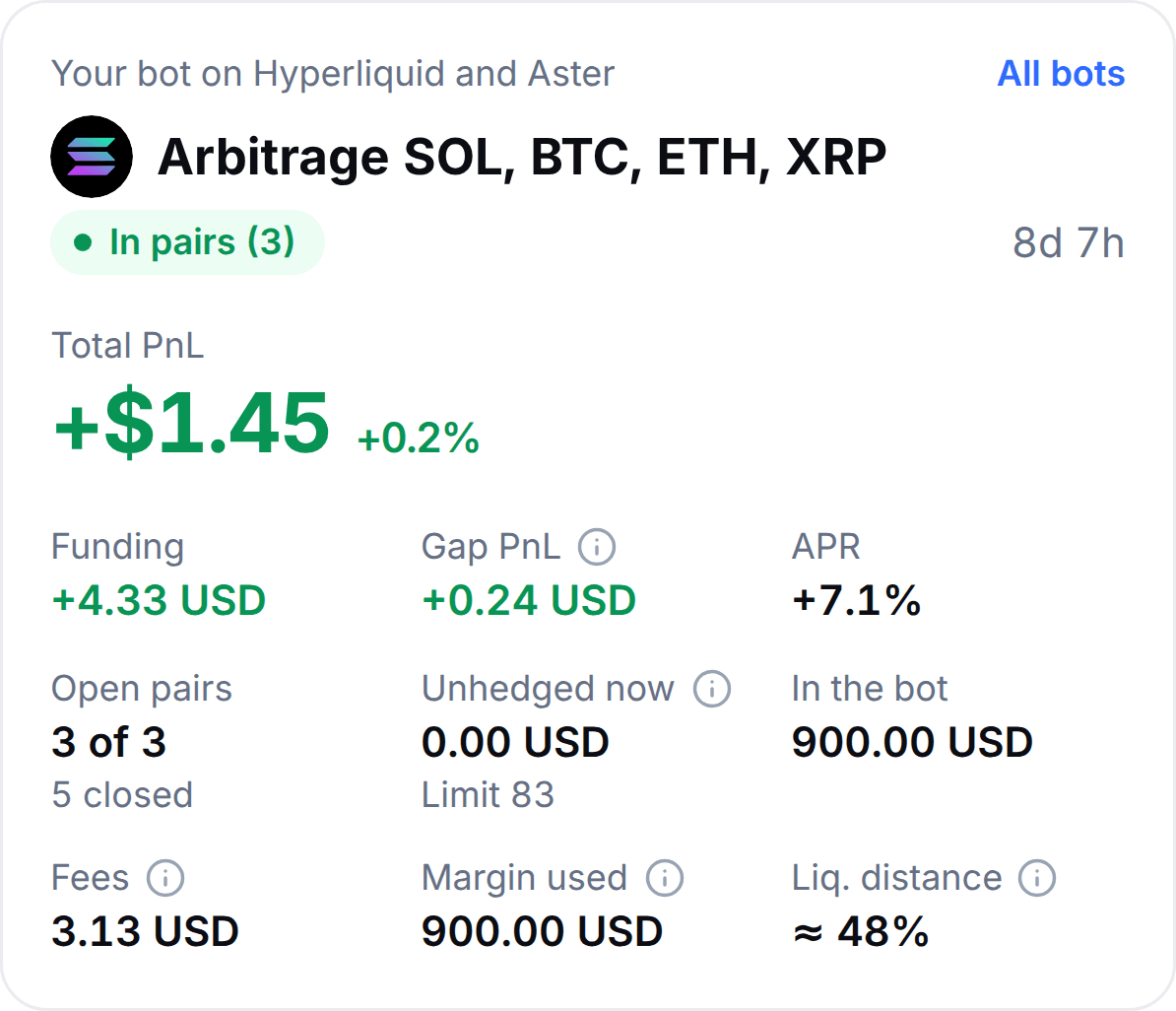
    It shows Total PnL, Funding, Gap PnL (what the two prices moving apart made or lost), Open pairs, Unhedged now (it should read $0), Fees, Margin used and Liq. distance, an estimate worked out from the leverage, not a reading of live positions. Stop closes all pairs at market, or keeps them with their stops. There is no Edit: the settings are part of the limits you signed, so to change one you stop the bot and start a new one.

On a phone, the card of a running Arbitrage bot: its total profit and loss, the funding and gap parts, the yearly rate, the open pairs, the money in the bot, the fees, the margin used and the distance to liquidation.
On a phone, a running bot on Nov 5, 2026: its profit and loss, its open pairs, its fees and its margin. The figures are a sample account's.

What do I control, and what can Prow not do with my keys?

Your money stays in your own accounts on Hyperliquid and Aster. The venues, not Prow, stop the key from withdrawing: it has no withdrawal permission. Prow's servers check every order against the limits you sign, and if they go down, the orders already on each venue stay, including every leg's stop and its mirror order. More in the Prow Bots key.

You set

  • Which coins, up to 10
  • How much money the bot may use, and the size of each pair
  • Leverage per leg, 1x to 3x
  • When it enters, how far ahead it looks and how long it may hold
  • The safety limits: unhedged amount and time, liquidation guard, venue stop, hedge slippage and max loss
  • Pause or stop, at any time

You sign

  • One Prow Bots key for each venue account. It lasts 30 days and you renew it with one signature.
  • The Prow fee on Hyperliquid, once.
  • The limits of each bot, 30 days at most. Prow's servers check every order against them and refuse the rest. They can't be renewed in place: to keep going, you stop the bot and start a new one.
  • 2 hours before the limits or the key end, the bot stops opening pairs and closes the open ones.

What the key can't do

  • Withdraw your funds
  • Send funds to another address or account
  • Approve another key
  • Move your money between Hyperliquid and Aster. If one venue runs short, you deposit there.

On Aster the key only works from Prow's servers. It could also move money between your own spot and futures balances inside the account, which Prow's servers never do for bots.

When does the arbitrage bot not pay?

  • Fees

    Every pair is four trades. At base rates that is about $20.00 on $10,000 per side before slippage: $13.00 to the venues and $7.00 to Prow. A gap that closes before it has paid that back is a loss.

  • The gap closes

    Funding gaps between venues usually close within days, and wide ones can close within hours. The bot assumes a gap fades and prices that in, which is why it asks for more than the fees.

  • Funding flips

    If funding turns against the pair, you pay on the leg you meant to collect on. The bot closes after two settlements in a row, so a couple of payments can go the wrong way.

  • One leg fills and the other does not

    A resting limit order tends to fill just before the price moves against it, and the hedge on the other venue can slip. The bot sells the first leg back, by default within 5 seconds, usually at a small loss.

  • One leg is stopped or liquidated

    Each leg has its own margin on its own venue, and the winning leg's profit can't be used as margin on the other. Leverage is capped at 3x, a guard closes the pair at 75% of the way to liquidation and stops sit on both venues, but in a fast move one leg can still close while the other stays open.

  • USDC against USDT

    Hyperliquid prices in USDC and Aster in USDT, and the two dollars trade slightly apart. Your profit and margin are in USDC on one venue and USDT on the other.

  • Money sits idle

    Margin stays on both venues while the bot waits, so the return on all the money committed is lower than the return on the days a pair is open.

  • The spreads above are the ones the bot sees. When none pays, it does nothing.

Questions about the arbitrage bot

What is a crypto arbitrage bot?

A crypto arbitrage bot is a program that watches the same coin on two markets and opens two opposite positions, a long on one and a short on the other, when the numbers say it pays. The two positions are the same size, so price moves mostly cancel and what is left is a difference, such as the difference in funding. Prow's Arbitrage bot does this between Hyperliquid and Aster perps, and between Hyperliquid spot and its perp.

Read more: How do crypto arbitrage bots work, and when do they pay?

How does funding rate arbitrage work between two perp DEXs?

A perp pays funding on a schedule: when the rate is positive, longs pay shorts. When the same coin has a lower rate on one venue and a higher rate on the other, the bot goes long where it is lower and short, in the same size, where it is higher. It pays the low rate, receives the high one and keeps the difference until the pair closes. Funding settles every hour on Hyperliquid and every 1 to 8 hours on Aster.

Read more: Funding rate arbitrage between Hyperliquid and Aster, Hyperliquid funding rates, explained

Is an arbitrage bot profitable?

Sometimes, and usually by little. A gap has to pay for four trades, and funding gaps between venues often close within days or turn around. That is why the bot opens a pair only when the expected funding pays its costs and your entry level, and why it waits most of the time. The two examples on this page show a gap that pays and one that does not, and the spreads list shows what pays right now.

Read more: Funding rates now, by venue

What does delta neutral mean, and is it risk-free?

Delta neutral, also called market-neutral, means the long and the short are the same size, so the coin's price going up or down changes the total very little. It is not risk-free. Each leg has its own margin on its own venue, so a sharp move can push one leg toward liquidation while the other leg's profit sits on the other venue. Funding can turn against the pair, and one leg can fill without the other. The bot limits these with leverage of 3x at most, a guard that closes the pair before liquidation, a stop on each venue and a cap on how long one leg may stand alone.

Read more: Is delta neutral risk-free? How hedged trades lose money

Can the bot withdraw my money?

No. It trades with a key called Prow Bots. The key can place and cancel the bot's orders and set leverage, but it cannot withdraw, send funds to another address or account, or approve another key. Withdrawals always need your own wallet. On Aster the key only works from Prow's servers, and on both venues it expires after 30 days unless you renew it with one signature.

Read more: The Prow Bots key, Hyperliquid agent wallets: why a trading key can't withdraw

How much money do I need?

You need free margin on both venues: USDC on Hyperliquid and USDT on Aster (a spot against perp pair needs USDC on Hyperliquid only). The builder shows what is free on each and checks that every order meets the venues' minimum sizes, which start at about $10. Fees are a percentage of the position, so a small pair needs the same size of gap as a large one to pay them back. By default the bot also leaves 20% of each venue free for your own trading.

Does the bot work on Lighter?

No. The scanner also lists pairs with Lighter so you can compare, but bots can't trade on Lighter: a Lighter pair that pays says "Bots can't trade on Lighter (view only)" where the other pairs have a Start button. Lighter keys can only sign inside your browser, so a server can't run a bot with them.

Read more: Perp DEX fees: Hyperliquid, Aster and Lighter compared

What does the arbitrage bot cost?

The venues' own fees on every trade, plus Prow's fee on every perp fill the bot makes: 0.025% on Hyperliquid and 0.01% on Aster. On Hyperliquid spot Prow's fee is on sells only, never on buys. On a $10,000 funding pair that is about $7.00 for the four fills. Prow's 0% launch fee, until Dec 31, 2026, is for orders you place yourself in the app: a bot pays the fee from its first fill. There is no subscription. Funding is not a fee: the bot pays it on one leg and receives it on the other.

Read more: Fees

How is it different from the arbitrage bots on Binance or OKX?

Exchange bots such as Binance's funding rate arbitrage bot and OKX's arbitrage order keep both legs on one exchange, usually a spot position against a perp, and the exchange holds your funds. Prow's bot works between two perp DEXs, Hyperliquid and Aster, and your money stays in your own account on each. Hummingbot, an open-source tool, can run funding arbitrage across exchanges, but you install and run it yourself. Checked on Nov 5, 2026.

Read more: Binance's funding rate arbitrage bot, OKX's arbitrage order, Hummingbot's funding rate script

Can I use it today?

Bots are switched on account by account. Any Prow account can open the spreads list and the builder, but starting a bot needs bots switched on for your account. If they are not, Continue stays off, nothing is signed or placed, and My bots says Bots aren't available on your account. You also need accounts on Hyperliquid and Aster linked in Prow, with money on both.

Read more: Arbitrage bot in the docs